Huawei's Hybrid Inverter System is Fully Powered by SiC
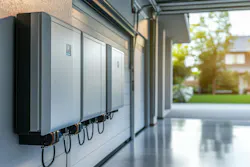
Huawei introduced what it called the industry's first all-in-one residential energy system. A full silicon-carbide (SiC) power architecture and fanless cooling was leveraged to boost efficiency, power density, and reliability.
The Luterra S2 integrates a hybrid inverter and battery storage system into a single, compact unit designed to compete with home battery systems such as the Tesla Powerwall. Huawei said the stackable architecture can deliver up to 20 kW of power from a single unit, while up to three inverters operate in parallel to provide as much as 60 kW. The S2 can also connect up to 48 battery modules in parallel, enabling energy storage capacities of up to 336 kWh.
Supporting single- (3 to 10 kW) and three-phase (5 to 20 kW) configurations, the solar inverter is based on Huawei's proprietary active neutral-point clamped (ANPC) topology, which taps the fast switching speeds, high efficiency, and reliability of the SiC MOSFETs. By switching faster than silicon and operating more efficiently at higher temperatures and higher voltages, SiC is key to driving up the power density of the system.
According to Huawei, the all-SiC architecture achieves up to 99% efficiency. This helps eliminates the need for external cooling fans, allowing for fully passive, 20-kW-class cooling. The fanless approach not only reduces operating noise, but also removes a common point of failure and saves space under the hood.
More important than the system itself is what it signals about the power-electronics market. In general, SiC remains more expensive than silicon. However, it's becoming widely used in areas such as EV traction inverters, battery energy storage systems (BESS), and AI data centers, where high device costs are offset by system-level efficiency gains. But a full-SiC architecture in a more consumer-facing residential energy system indicates the economics are changing.
The shift is being driven in part by manufacturing innovations from the likes of Wolfspeed and Infineon, which are both upgrading to 300-mm wafers that could help significantly reduce the cost-per-device of SiC.
Huawei said the system was engineered to maximize the power-handling capabilities of SiC. The ANPC topology replaces the passive clamping diodes of a traditional three-level neutral-point clamped (NPC) inverter with active power switches such as SiC MOSFETs, helping to curtail losses and improve efficiency. In a standard three-level ANPC phase leg, each leg typically uses six switches rather than four switches and a pair of diodes.
By replacing passive diodes with active switches, the ANPC topology is able to perform bidirectional power control, which is well-suited for solar inverters and other grid-connected renewable energy systems, battery energy storage, motor drives, and EV DC wallboxes. ANPC also supports various pulse-width-modulation (PWM) strategies to minimize switching losses and lower dv/dt stress.
One of the drawbacks of the NPC topology is that it experiences unequal thermal stress and power distribution between the inner and outer switches. ANPC solves this by allowing for flexible switching sequences that distribute heat evenly across all devices, helping prevent localized hot spots and improving reliability.
Huawei's new system is backed by built-in energy optimizers that enable up to 5 MWh/kWh of lifetime usable energy and a design lifespan of more than 15 years.
The company said it engineered safety into the S2 at several different levels. Every battery cell incorporates an independent isolation structure designed to prevent faults from spreading, supported by proprietary safety components and cell-level thermal insulation that helps contain thermal events before they can spread throughout the pack.
The system also features an intelligent smoke-venting design. It can release pressure, evacuate smoke, and assist with cooling in the event of a failure.
Continuous monitoring of both AC and DC terminal temperatures provides early detection of abnormal heating at critical electrical connections, enabling more proactive protection.
Rated for operation from −25 to +60°C and protected by an IP66 enclosure, the system is designed to withstand a wide range of environmental conditions.
Said Steve Zhang, president of Huawei's distributed solar and battery energy storage business, "By combining full-SiC architecture, AI-driven energy management, and industry-leading safety, Luterra S2 is designed to be smaller, lighter, quieter, safer, smarter, and more powerful than ever before."
About the Author
 James Morra
Senior Editor
James Morra is the senior editor for Electronic Design, covering the semiconductor industry and new technology trends, with a focus on power electronics and power management. He also reports on the business behind electrical engineering, including the electronics supply chain. He joined Electronic Design in 2015 and is based in Chicago, Illinois.
Related
 Battery_Energy_Storage_Facility_Stock

Comment About the Article
To join the conversation, and become an exclusive member of Electronic Design, create an account today!
 Leaders Logo
Leaders relevant to this article: