GaN-Based Auxiliary Power Supplies Gear Up for Data Centers

While auxiliary power supplies account for only a fraction of a modern AI server’s power budget, they remain vital. They power all of the microcontrollers, gate drivers, op amps, and other ICs responsible for control, monitoring, and other housekeeping functions that ensure system reliability, safety, and efficiency.
As AI data centers get more power-hungry, shrinking these support circuits is becoming key to maximizing rack-level power density and optimizing the limited space within newer 800-V DC power architectures.
On that front, Power Integrations is applying gallium nitride (GaN) to the problem. The company revealed a new series of ultra-slim, compact auxiliary power-supply reference designs engineered specifically for the 800-V DC bus inside NVIDIA’s next-generation Kyber racks.
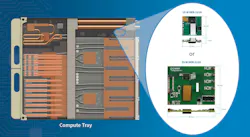
The first power supply is a 15-W single-output flyback converter measuring only 30 × 30 mm with a 7-mm profile, while the other is a 35-W isolated multi-output DC-DC converter measuring 80 × 60 mm with an 8-mm profile. Power Integrations said their compact form factors can free up approximately 30% of the PCB area typically occupied by auxiliary power circuits on the main power-distribution boards (PDBs). That also translates to a roughly 30% reduction in the bill-of-materials (BOM) count.
The 800- to 14-V power supplies are both based on the company’s InnoMux-2 power ICs, which integrate 1,700-V-rated PowiGaN technology into a single device. The high-voltage GaN HEMT supports nominal input voltages of up to 1,000 V DC in flyback-converter configurations. As a result, it’s well-positioned for 800-V DC power architecture supported by NVIDIA and the ±400-V DC systems being pushed by Google, Meta, Microsoft, and others.
Powering Kyber: More Than Half a Megawatt Per Rack
The new power supplies are specifically designed to slot into the Kyber architecture due out in 2027. Kyber is a liquid-cooled, blade-rack architecture bundling up to 576 Rubin Ultra GPUs along with its Vera CPUs. NVIDIA said a fully populated rack could draw up to 600 kW of power. That’s more than 4X the 120 kW of power used by current Blackwell B200 racks, highlighting a steep rise in AI power demand going forward.
To handle all of that power without wasting valuable space, Kyber separates power delivery from compute resources. Each compute rack is paired with a dedicated power rack, or “sidecar,” freeing up more space for computing, networking, and storage.
To feed it all efficiently, Kyber adopts 800-V DC power distribution instead of traditional 415- or 480-V AC three-phase power that flows into today’s fully-integrated server racks, where a power supply converts AC into 54 V or 48 V DC power that flows up and down the rack.
One of the primary reasons for this is to reduce copper usage. NVIDIA estimates that delivering 600 kW over a traditional 54-V DC bus would require massive copper busbars to handle the ultra-high currents, with one weighing more than 400 pounds. In the Kyber architecture, the 800-V DC bus runs from the sidecar to the compute rack, where the main PDB converts and distributes power to the AI servers. The higher voltage enables roughly 2.5X more power to be pushed through the same amount of copper.
Efficiency is the other key advantage of 800-V DC power. High-voltage DC (HVDC) architectures cut down on the number of AC-DC and DC-DC conversion stages between the grid and the processor itself, which inevitably boosts efficiency. Also, high-voltage power is delivered from the sidecar and converted closer to the compute hardware, decreasing the amount of current racing through the busbars. That helps reduce not only distribution losses, but also the heat that comes with them.
Jason Yan, senior training manager at Power Integrations, said the single-HEMT 1,700-V GaN devices are the key to designing efficient flyback converters while maintaining the wide safety margins required by a 800-V DC bus. He added, “The only alternative solutions are discrete, costly silicon-carbide (SiC) devices, which require 30% more components and space to operate,” and that can be impractical for densely packed power boards.
With the GaN power HEMT delivering up to 90% efficiency in discontinuous conduction mode (DCM), Power Integrations said the reference designs achieve at least 88% efficiency across both line and load conditions. The reference designs include the DER-1110, a 35-W multi-output auxiliary power supply that steps down input voltages of 800 V DC to output voltages of 14 V DC, and the DER-1114, a 15-W single-output version using the same controller.
About the Author
 James Morra
James Morra
Senior Editor
James Morra is the senior editor for Electronic Design, covering the semiconductor industry and new technology trends, with a focus on power electronics and power management. He also reports on the business behind electrical engineering, including the electronics supply chain. He joined Electronic Design in 2015 and is based in Chicago, Illinois.