Current-Sense Resistors Take on High-Current Automotive, Industrial Designs
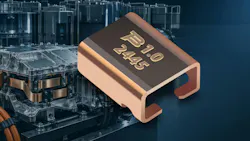
The CSS4C-1216 series of AEC-Q200-compliant current-sense resistors from Bourns now features new resistance values and tolerance options, including a ±3% tolerance offering. The automotive-grade series is designed for high-current applications that require accurate current measurement, low inductance, and stable performance under demanding operating conditions.
Among its target applications are current sensing, battery-management systems, power modules, frequency converters, and industrial electronics.
Created for automotive apps, the series is able to maintain stable electrical characteristics while operating under elevated temperatures and continuous load conditions. It addresses these requirements with e-beam welded metal strip construction, low inductance of less than 2 nH, and a four-terminal Kelvin configuration that improves current measurement accuracy. The series is also AEC-Q200 compliant, supporting use in automotive applications where validated reliability data is required.
Design Features and Key Capabilities
EB welded metal strip construction: Supports excellent long-term stability in current-sensing applications.
- High power: Up to 5 W at 100°C.
- Low inductance of less than 2 nH to help reduce measurement error in high-current circuits.
- Excellent long-term stability for reliable performance over time.
- Four terminals for high accuracy: Improves current measurement accuracy.
- AEC-Q200 compliant: Meets applicable AEC-Q200 component qualification requirements.
The Bourns CSS4C-1216 series is available now through the company’s authorized distribution network. Full specifications and ordering information are available here.
About the Author
 Lee Goldberg
Contributing Editor
Lee is the author of the popular PowerBites series.
Lee Goldberg is a self-identified “Recovering Engineer,” Maker/Hacker, Green-Tech Maven, Aviator, Gadfly, and Geek Dad. He spent the first 18 years of his career helping design microprocessors, embedded systems, renewable energy applications, and the occasional interplanetary spacecraft. After trading his ‘scope and soldering iron for a keyboard and a second career as a tech journalist, he’s spent the next two decades at several print and online engineering publications.
Lee’s current focus is power electronics, especially the technologies involved with energy efficiency, energy management, and renewable energy. This dovetails with his coverage of sustainable technologies and various environmental and social issues within the engineering community that he began in 1996. Lee also covers 3D printers, open-source hardware, and other Maker/Hacker technologies.
Lee holds a BSEE in Electrical Engineering from Thomas Edison College, and participated in a colloquium on technology, society, and the environment at Goddard College’s Institute for Social Ecology. His book, “Green Electronics/Green Bottom Line - A Commonsense Guide To Environmentally Responsible Engineering and Management,” was published by Newnes Press.
Lee, his wife Catherine, and his daughter Anwyn currently reside in the outskirts of Princeton N.J., where they masquerade as a typical suburban family.