How Do You Measure Biological Thermal Picowatts?
What you'll learn:
- Why calorimetry is an important factor in biological research.
- The challenges of measuring the picowatt-range heat given off in a small-scale biological reaction.
- How a unique calorimeter has overcome these challenges, and how it’s calibrated.
I’ve always been fascinated by extreme analog-sensor measurement schemes, where “extreme” can mean precision, magnitude (small and large), or ruggedness. Perhaps that interest was inspired by the late legendary Jim Williams’ classic 1976 article “This 30-ppm scale proves that analog designs aren't dead yet,” which I have cited many times as an example of meticulous analog design.
That’s why I was intrigued by a project at Harvard’s School of Engineering and Applied Science (SEAS) detailing some work in measuring the picowatts given off by living cells during biological activity. When living cells grow, divide, or respond to drugs, they give off tiny amounts of heat that offer information about what the cells are doing.
At present, biologists often only measure cellular metabolism via indirect calorimetry; for example, by measuring oxygen consumption or chemical byproducts. A sensitive and accurate pico-calorimeter that can track the metabolism of small populations of bacteria in real-time, as well as monitor how bacterial growth changes in response to different antibiotics, would offer experimental benefits.
The new device builds on roughly two decades of work on micro- and pico-calorimetry in the group. They initially developed nano-calorimetry systems for studying phase transformations in thin-film shape memory alloys and metallic glasses. Over time, their work shifted to exploring ultra-sensitive calorimetry methods for biological applications, including measurements of metabolic heat in large cells and developing embryos.
Building the Pico-Calorimeter
While I don’t have an interest in biological experiments themselves, I’m interested in the picowatt (10-12 W) metrology. In this range, second- and third-order effects and disturbances that are normally negligible become significant, as seen in the latest attempt to measure the universal gravitational constant G with extreme precision (see References).
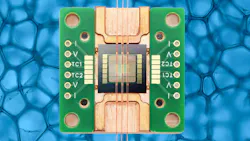
In contrast to indirect calorimetry, the SEAS device measures the heat itself (remember, this is thermal power and not electrical power, so it’s much harder to measure). The pico-calorimeter is assembled on a metal mount with a custom printed circuit board (Fig. 1).
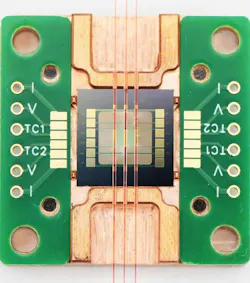
The core sensor consists of three microscopic glass capillaries mounted on an extremely thin micromachined membrane. One capillary contains the biological sample in liquid growth medium, while the other two serve as references. The capillaries and sensors are housed inside a vacuum chamber to keep them thermally isolated.
The sample and two reference capillaries are bonded to a thin silicon-nitride membrane within a silicon frame that provides structural support. Embedded in the membrane are two low-noise Nichrome/Constantan thermopiles. To ensure good thermal contact between the capillaries and the membrane, glass capillaries with square cross-sections are used and adhered to the membrane with a thin polymeric layer (Fig. 2).
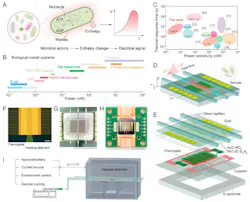
In addition, a thin gold coating in the regions where the capillaries contact the membrane enhances the temperature uniformity within these areas. The heating element is patterned in a four-lead configuration, allowing direct determination of power dissipation by measuring the applied current and the voltage drop across the heating element.
The capillaries and sensors are housed inside a vacuum chamber to keep them thermally isolated and maintained at 27°C. This design boosts sensitivity by an order of magnitude compared with earlier generations of the pico-calorimeter developed by this team. (Previous versions used liquid droplets on a suspended membrane, while the new vacuum-sealed, microfluidic design makes the new sensors easier to operate and more robust.)
As cells in the sample grow and consume nutrients, they release heat, creating minute temperature differences between the sample capillary and the references. A nearby thermopile reads out the temperature differentials.
What About Calibration?
With any sensor, especially a picowatt-range sensor such as this one, calibration and confidence in readings is a legitimate issue. Here, a micromachined tungsten heating element is integrated into the sample capillary region to calibrate the sensor and correlate its output to the heat dissipated in the sample. Current pulses were applied and corresponding voltages were recorded (Fig. 3). The sensor response is linear across the entire range of input power.
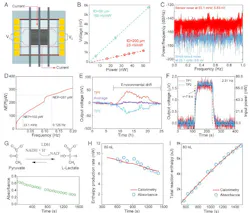
Then there’s noise. Whenever you’re in the pico-whatever range, noise can wipe out any meaningful signal. Here, at a bandwidth of 23.1 mHz (biological process can be very slow), the noise is 6.63 nV, which is consistent with noise arising primarily from Johnson-Nyquist noise in the thermopile (5.36 nV) with only a small contribution from noise in the voltmeter (0.80 nV).
Beyond up-front modeling, simulation, and actual data, the team did statistical analysis on signal, noise, and related factors and determined a resolution of 103 pW for the sensor with 200- × 200-μm capillaries and a sample with uniformly distributed power dissipation. It was only slightly higher than the predicted noise-equivalent power (NEP) of 80 pW. Similarly, they achieved resolution of about 24 pW for the sensor with 50- × 50-μm capillaries.
The work is detailed in their paper “A pico-calorimeter for cellular metabolism and antimicrobial susceptibility testing” published in the Proceedings of the National Academy of Sciences. While that version is behind a paywall, the Harvard team has also posted it at an internal site.
I am always impressed by — and learn a lot from — these nano- and pico-level analog-sensing projects. While machine learning and AI can help improve the data analysis, it’s almost always better to try to get the raw data as good as possible, before resorting to the “magic” of ML and AI to further improve the analysis.
References
“This 30-ppm scale proves that analog designs aren't dead yet,” EDN.
“Redetermination of the gravitational constant with the BIPM torsion balance at NIST,” Metrologia.
“NIST Weighs In on the Mystery of the Gravitational Constant,” NIST News.
About the Author
 Bill Schweber
Bill Schweber
Contributing Editor
Bill Schweber is an electronics engineer who has written three textbooks on electronic communications systems, as well as hundreds of technical articles, opinion columns, and product features. In past roles, he worked as a technical website manager for multiple topic-specific sites for EE Times, as well as both the Executive Editor and Analog Editor at EDN.
At Analog Devices Inc., Bill was in marketing communications (public relations). As a result, he has been on both sides of the technical PR function, presenting company products, stories, and messages to the media and also as the recipient of these.
Prior to the MarCom role at Analog, Bill was associate editor of their respected technical journal and worked in their product marketing and applications engineering groups. Before those roles, he was at Instron Corp., doing hands-on analog- and power-circuit design and systems integration for materials-testing machine controls.
Bill has an MSEE (Univ. of Mass) and BSEE (Columbia Univ.), is a Registered Professional Engineer, and holds an Advanced Class amateur radio license. He has also planned, written, and presented online courses on a variety of engineering topics, including MOSFET basics, ADC selection, and driving LEDs.
Comment About the Article
To join the conversation, and become an exclusive member of Electronic Design, create an account today!
 Leaders Logo
Leaders relevant to this article: