What’s New in DAQ from NI?
What you’ll learn
- What’s new in NI’s CompaqDAQ?
- Check out the new snap-in connectors.
- What’s the latest high-precision DAQ?
There were a number of new data-acquisition announcements at Emerson’s NI Connect 2026. In this video overview, NI’s Brett Burger discusses some of them, which are described below. While NI’s Nigel AI assistant garnered a lot of eyeballs, there was a good deal of hardware being shown off at the conference.
Making CompactDAQ a Snap
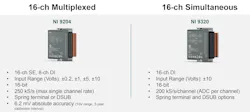
NI’s well-known CompactDAQ series received a few new additions, including a set of 16-channel, ±10-V modules that are available in multiplexed or simultaneous versions (Fig. 1). The multiplexed version has 16 single-ended or eight differential inputs. They offer 250 and 200 kSPS/channel, respectively.
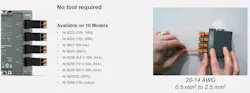
NI also added a new snap-in connector option (Fig. 2). The connectors handle 20 (0.5 mm2) to 14 (2.5 mm2) AWG wires. These are especially handy when doing bench testing.
NI added small, Ethernet and USB-C CompactDAQ chassis to its repertoire (Fig. 3). The single-port Ethernet chassis, designed for end-of-chain connections, are available in 4- and 8-slot versions. Both support time-sensitive networking (TSN) for real-time applications.
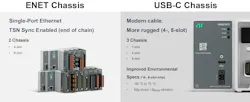
There are 1-, 4- and 8-slot USB-C chassis. The 4- and 8-slot versions are designed for more rugged applications supporting temperatures from −40 to 70°C and 50 g shock / 5 gRMS vibration.
High-Speed PCIe
The new 32-channel PXIe-4311 targets power-consumption application platforms like CPUs, GPUs, FPGAs, and more (Fig. 4). The boards handle 4 MSPS with a 12- to 22-bit resolution. The resolution depends on a number of factors, including sample rate and voltage range. The sampling rate is configurable with a fixed-rate ADC configuration.
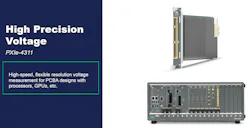
The board has an 800-kHz bandwidth and can handle differential inputs with voltage ranges of 150 mV, 0 to 6 V, and 0 to 25 V. Cables and terminal blocks are compatible with the 32-channel, 28-bit ADC PXIe-4309.
The board is supported by NI’s FlexLogger with DAQmx sync support. It has full streaming support with on-board processing for calculated Virtual Power.
Cutting Up FieldDAQ
FieldDAQ comes in a number of flavors that differ by connections and application (Fig. 5). They all have an operating temperature range of -40 to 85 °C, and can handle shocks up to 100 g and vibration up to 10 gRMS; plus they feature a IP65/67 rating (1 m submergible for 30 minutes). Each has an Ethernet port built-in switch.
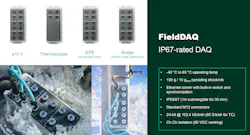
The FieldDAQs use standard M12 connectors. Internally, they have a 24-bit, 102.4-kSPS/channel. The thermocouple versions run at 85 samples/s/channel.
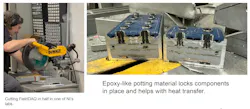
You can’t take a FieldDAQ apart, but if you want to look under the hood, then check this out (Fig. 6). NI engineers cut one open for you. This exposes the epoxy-like potting material encasing the electrical components. This also helps with heat transfer.
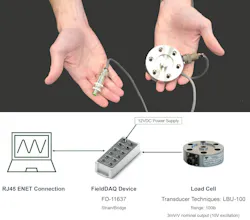
The LBU-100 load cell is one way to link transducers to FieldDAQ (Fig. 7). Like the FieldDAQ, this hardened system is designed for field deployment.
About the Author
 Brett Burger
Brett Burger
Chief Solution Marketer and Head of DAQ marketing @ NI/Emerson
Brett Burger is the head of DAQ marketing and a chief solution marketer for validation at NI, now part of Emerson. Brett has 20 years of experience in the test and measurement industry with application knowledge of machine condition monitoring, smart-grid applications, power quality, the industrial IoT, sensors, and data acquisition. Brett has a B.S. in Aerospace Engineering from Texas A&M University, is a father of two, and lives in Austin, Tex., where he enjoys the local beer, barbecue, and breakfast tacos.
 William G. Wong
William G. Wong
Senior Content Director - Electronic Design and Microwaves & RF
I am Editor of Electronic Design focusing on embedded, software, and systems. As Senior Content Director, I also manage Microwaves & RF and I work with a great team of editors to provide engineers, programmers, developers and technical managers with interesting and useful articles and videos on a regular basis. Check out our free newsletters to see the latest content.
You can send press releases for new products for possible coverage on the website. I am also interested in receiving contributed articles for publishing on our website. Use our template and send to me along with a signed release form.
Check out my blog, AltEmbedded on Electronic Design, as well as his latest articles on this site that are listed below.
You can visit my social media via these links:
- AltEmbedded on Electronic Design
- Bill Wong on Facebook
- @AltEmbedded on Twitter
- Bill Wong on LinkedIn
I earned a Bachelor of Electrical Engineering at the Georgia Institute of Technology and a Masters in Computer Science from Rutgers University. I still do a bit of programming using everything from C and C++ to Rust and Ada/SPARK. I do a bit of PHP programming for Drupal websites. I have posted a few Drupal modules.
I still get a hand on software and electronic hardware. Some of this can be found on our Kit Close-Up video series. You can also see me on many of our TechXchange Talk videos. I am interested in a range of projects from robotics to artificial intelligence.