The Intelligent Future of Digital Power Supplies
What you'll learn:
- How fully digital architectures are transforming power-supply design from the inside-out.
- The role of SiC and GaN power FETs to enable higher efficiency and smaller form factors.
- How intelligent diagnostics provides deeper insight into power supply and application health.
- The importance of intuitive user interfaces to improve power-supply usability and safety.
- How digital power-supply control enhances security, flexibility, and operational safety.

All electronics engineers want the same things out of their systems: faster speeds, smaller footprints, and enhanced power. This drive places increasingly stringent demands on power supplies, which must now deliver more power from ever more compact designs while maintaining superior efficiency, reliability, and control.
Historically, power supplies were often regarded as mere “dumb boxes” solely responsible for converting alternating current (AC) from a single- or three-phase source and delivering a stable DC voltage to electronic devices. However, the rise of fully digital architectures is changing that outlook. They’re elevating power supplies to intelligent components that can provide critical insights into the overall health of the power supply itself as well as the application it’s integrated into.
Analog Limits to Digital Control: The New Power-Supply Architecture
A significant shift in modern power-supply design is the move toward a truly digital architecture. In the past, many configurable power supplies, while claiming digital communication capabilities, often featured only a digital input stage paired with analog-controlled output modules that limited the extent of available control and diagnostics.
Today, advanced digital power supplies are designed from the ground up to be digitally controlled, configured, and monitored across both their input stage and individual output modules. This inherently digital design, often utilizing internal communication protocols like the CAN bus, facilitates faster and more accurate control, alongside access to deeper and richer datasets essential for advanced diagnostics. The results are improved response times, higher reliability, and superior predictive capabilities than legacy analog systems.
How SiC and GaN are Powering Progress in Power Supplies
Another key factor driving progress in digital power supplies is the adoption of power switches based on wide-bandgap (WBG) technologies, specifically silicon carbide (SiC) and gallium nitride (GaN). These advanced materials enable FETs to run at significantly higher switching frequencies than traditional silicon MOSFETs.
In turn, WBG materials help reduce energy loss during charging and discharging, and, thus, the need for energy storage. This enables power supplies to leverage smaller inductors and capacitors, shrinking the power supply’s overall size.
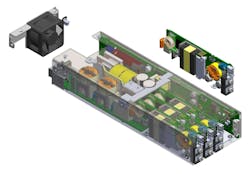
Consequently, modern digital power supplies can mitigate the usual tradeoffs faced by engineers. Using SiC and GaN, they’re able to achieve larger power outputs and significant increases in efficiency that result in higher power densities in smaller package sizes. Therefore, when choosing a digital power supply, prioritizing those that use WBG technologies can lead to greater installation flexibility in smaller user application designs.
How Digital Power Supplies Open a Window into Application Health
The future of digital configurable power supplies lies squarely in their intelligence. Unlike the “dumb boxes” of yesterday, today’s advanced power supplies can transform internal data into actionable insights for users and control systems.
Engineers should look for intelligent power-supply technologies that offer meaningful and intuitive diagnostic capabilities. This includes predictive diagnostics, where the unit can trend and log parameters over time via its user interface, enabling potential issues to be identified before there’s a failure. A prime example of this foresight is the ability to monitor fan speed in relation to internal board temperatures, which alerts users to potential problems prior to unit failures.
Download the PDF of this article, and check out the TechXchange for similar articles and videos
 dreamstime_kjetilkolbjornsrud_29553801
Furthermore, power supplies such as the FLXPro series add features that record not only the status of the power supply at the exact moment of an event, but also capture performance data leading up to that event. This historical information can be vital for understanding the root cause of a failure, which traditional power supplies are rarely able to determine, as they often only focus on data at the point of shutdown.
A digital power supply should also be able to store multiple shutdown events, enabling comparative diagnostics. Importantly, this diagnostic data should be stored in non-volatile memory (NVM) on a separate communications board. Such a board must be accessible and be able to be interrogated even if the main output modules are damaged, much like an aircraft's flight recorder. This allows for a deeper level of insight: Instead of just knowing “what happened,” it’s possible to understand “why it happened,” “when it happened,” and “what happened in the lead-up.”
The FLXPro series integrates XP Power’s new intelligent power technology, called iPSU, which extracts and records this data, leading to immediate actionable insights should an event occur. This represents a significant leap forward over existing configurable power supplies.
Securing the Power Supply: The Move to Multilevel Protection
With the increasing prevalence of cyber threats and new regulatory demands, enhanced security has become a critical consideration for digital power supplies. Whereas traditional power supplies offered little to no protection, modern digital power supplies, being part of an application’s attack surface, must incorporate robust security measures.
When selecting a digital power supply, look for multilayer, secure password protection schemes. These should feature distinct levels of password control to protect against unauthorized configuration changes, restrict firmware updates, and prevent access to factory-level calibration parameters. Such features drastically reduce the attack surface that bad actors can exploit.
The ability for customers to set their own strong passwords further enhances security and helps align end applications with cybersecurity regulations. The FLXPro series uniquely incorporates multilayer password protection, reducing regulatory and safety compliance requirements for sensitive applications, such as medical instrumentation.
Intuitive UI Design: Making Digital Power Supplies Easier and Safer to Use
The effectiveness of advanced features ultimately depends on their usability. Previous power-supply interfaces often compelled users to view one output at a time during critical situations. Today’s digital power supplies, developed using human-centered design (HCD) principles, now focus on meeting the user’s needs, desires, and context of use.
An intuitive user interface (UI) is paramount. Look for UIs that include a dashboard displaying the simultaneous viewing of multiple outputs, internal diagnostics, alarm status, and key variable trending. Integrated tools, such as a built-in oscilloscope function for real-time monitoring, graphing, data logging, and data export, are invaluable for streamlining product development and troubleshooting. Visual simplicity must be a core design principle.
An effective UI should employ clear visual prompts, such as a “traffic light system” (red/yellow/green), where green indicates good status, amber a warning, and red a fault. It should also cater to color-blind users by providing unique visual cues through flashing patterns or text, ensuring all status indicators are interpretable regardless of color perception.
In addition, color-coded connections can instantly convey output configuration status, especially for applications involving outputs tied in series or parallel. The interface also should be intuitive enough that users can perform tasks like configuration, trending, data logging, and enabling advanced features without the need for extensive (and expensive) training.

Flexible, Safer Power Delivery Through Advanced Digital Control
Finally, the flexibility and operational safety of a digital power supply are critical. Look for a wide range of adjustable output module options that can simplify unique application requirements and reduce development time, complexity, and cost.
A key capability to prioritize is the ability to switch individual isolated outputs on and off digitally or via external voltage inputs, without shutting down the entire unit. This greatly enhances test and integration safety and reduces test-harness complexity. It also simplifies troubleshooting by allowing isolation of different sections of an end-user system. The FLXPro series provides this functionality and the significant safety improvements that result from system-integrated isolated output control.
Moreover, modern digital power supplies should offer robust operational safety features, such as ES1-rated communications for touch safety (ensuring maximum voltages remain below 60 V DC) and appropriate Means of Patient Protection (MOPP) isolation for medical applications. They help simplify compliance and eliminate the need for additional external safety components.
The innovations introduced in products like the FLXPro series reflect the broader industry shift into the digital age. By adding intelligence and improving the user experience, digital power supplies are evolving into critical system components that reliably supply power. On top of that, they provide trusted windows into the health of end applications, enhancing safety, reducing operating costs, and significantly streamlining the entire development process.
Download the PDF of this article, and check out the TechXchange for similar articles and videos
dreamstime_kjetilkolbjornsrud_29553801About the Author
Simon Wheeler
VP of Product Management, XP Power
Simon Wheeler is Vice President of Product Management at XP Power. He has decades of experience in design engineering and in leading global product management for blue-chip instrumentation, electronics, and software firms.
Comment About the Article
To join the conversation, and become an exclusive member of Electronic Design, create an account today!
 Leaders Logo
Leaders relevant to this article: