Power Sequencing, Simplified
What you'll learn:
- Why proper power sequencing is important for multi-rail processors, and what can happen without it.
- The pros and cons between the most common approaches to power sequencing in multi-rail-powered systems.
- The details on a new solution that uses passive components to control the power-up and power-down timing of different power rails.
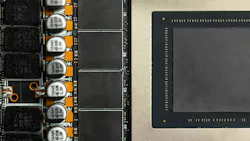
From graphics processor units (GPUs) and central processing units (CPUs) to field-programmable gate arrays (FPGAs), digital signal processors (DSPs), and heterogeneous SoCs, every processor requires power sequencing. These digital loads often operate from multiple voltage rails, each of which may supply a different on-chip power domain. Power sequencing is the process of applying and removing power from these voltage rails in a specific order during system startup and shutdown.
If the appropriate sequencing isn’t followed, the function of the load may be limited and defective. Also, in extreme cases, the load can be destroyed. To prevent this, sequencing functions are employed.
This article discusses different possibilities for the implementation of a sequencing and voltage-monitoring function. It also introduces a new, simple-to-use sequencing solution that requires no programming, digital communication, or bias power supply. These features are important because the sequencer itself needs to be powered on first in a system. By that time, processors or other loads usually aren’t running yet.
How Power Sequencing Typically Works
One common approach to sequencing involves placing several DC-DC converters in front of the processor and switching them on one after the other by linking the generated voltages with enable (EN) pins. One drawback with this approach is the requirement of voltage regulators with an exact definition of the precision enable pin. The other drawback is that a fixed sequence of switch-off of the individual voltages is difficult to implement. Also, the exact time course can only be implemented with additional cumbersome circuitry.
Given all that, a dedicated sequencing controller is often preferred. Figure 1 outlines such a system. The voltage converters — from the first, DCDC1, to the last, DCDC n — are switched on and off by a sequencer in the correct order through the respective enable pins.
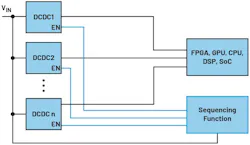
Ideally, the sequencing circuit should support a wide input voltage range since it needs to perform its function before the respective voltages in the system are switched on. Thus, a wide operating input voltage range is favorable.
The sequencing function can be implemented in several different ways. A microcontroller (MCU), a small FPGA, a dedicated programmable power sequencer, or a simple sequencer could be used, depending on the complexity and flexibility required.
Many of these solutions have unfavorable limitations. The MCU must first power up and execute its firmware before it’s able to perform the sequencing function. A small control FPGA or a programmable power sequencer must be programmed before operation. This can be completed before the device is soldered onto the PCB or after assembly, prior to the system's initial power-up. In both cases, the additional programming step can lead to considerable effort and costs.
System designers need to contend with the increasing complexity of power sequencing. Today’s electronic systems need more power density, with the number of voltage rails growing at both the chip and system levels.
Today's processors are more heterogeneous than ever. Multi-core CPUs are crowding onto the same silicon die as on-chip accelerators, such as GPUs and NPUs, as well as memory controllers, high-speed SerDes, and I/O interfaces like PCIe. Each of these subsystems may require a different supply voltage to run efficiently. To manage this complexity, chip designers partition the processor into independent power domains, often with dedicated voltage rails. This enables fine-grained power management, allowing idle blocks to be completely shut off or dialed down independently.
As a result, a single processor may contain a dozen or more voltage rails and power domains, while the complete system can include dozens or even hundreds of interdependent power rails and voltage domains.
Supplying power to all these rails without considering the power-up and power-down timing for each one can cause a system failure. Improper sequencing can also increase the risk of damage to the processor or any of the chips surrounding it. One of the big concerns is the possibility of breakdown in the electrostatic-discharge (ESD) protection and isolation barriers that internally separate power rails in a chip.
If one rail remains powered while another is inactive for extended periods — or repeatedly experiences these conditions over time — such protections can break down, potentially causing permanent damage to the chip. — James Morra
A New, Simple-to-Use Approach to Power Sequencing
An alternative approach eliminates the need for programming in production. In this type of sequencing solution, timing and operating behavior are configured using only external resistors and capacitors. With a very wide input voltage range of 2.7 to 15 V, this sequencer can be operated directly from a 3.3-, 5-, or even 12-V supply voltage without needing an additional power supply for the sequencer itself.
Another advantage, as seen in Figure 2, is that the different voltages (from V1 to V8) are monitored separately. Only when all voltages have reached a predetermined value, a power OK signal is given. One of the most important metrics when it comes to voltage monitoring is accuracy. Monitoring accuracy is a part of the overall accuracy of each voltage generated by a DC-DC converter. The ADM6840 comes with a voltage monitoring accuracy of ±0.8%.
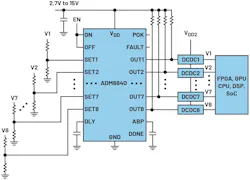
While accuracy is a critical factor for the power sequencer, reliability is also key to keeping the circuit well-protected. The ADM6840 can be operated in a temperature range between –40 and +125°C, which is helpful since many circuits often become quite hot. If more than eight channels are needed, several sequencers can be operated together.
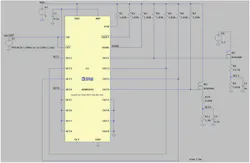
Evaluating the function of the ADM6840 sequencer can be simplified by using LTspice. Within LTspice, the sequencer is available in an example circuit. Figure 3 shows the simulation environment in which different setups can be simulated.
Selecting the Right Components for Power Sequencing
Powering a modern, multi-rail processor is challenging enough without adding the complexity of power sequencing. With the new solution, however, sequencing can be straightforward to implement. In most applications, no additional auxiliary power supply is required, nor is there any need for complex, time-consuming programming. As a result, engineers are able to save themselves development time, while ensuring safe, reliable system startup and shutdown.
>>Download the PDF of this article
 dreamstime_oliversved_216915481
About the Author
 Frederik Dostal
Frederik Dostal
Power-Management Technical Expert
Frederik Dostal is a power-management expert with more than 20 years of experience in this industry. After his studies of microelectronics at the University of Erlangen, Germany, he joined National Semiconductor in 2001, where he worked as a field applications engineer, gaining a lot of experience in implementing power-management solutions in customer projects. During his time at National, he also spent four years in Phoenix, Arizona (USA), working on switch-mode power supplies as an applications engineer.
In 2009, he joined Analog Devices, where since then he held a variety of positions working for the product line and European technical support, and currently brings in his broad design and application knowledge as a power-management expert. Frederik works in the ADI office in Munich, Germany.
Also check out my:
Comment About the Article
To join the conversation, and become an exclusive member of Electronic Design, create an account today!
 Leaders Logo
Leaders relevant to this article: