Regulation Loop Without a Resistive Divider
What you'll learn:
- A look at the unity-gain architecture, a superior alternative to typical regulation methods.
- How the new architecture lowers the noise, particularly at frequencies below 100 kHz.
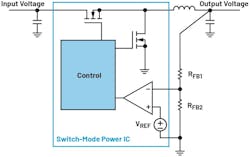
Power converters typically incorporate a control loop to maintain a set output voltage, irrespective of variations in input voltage or load current.
A resistor divider is often used to sense output voltage. Figure 1 shows one example—a step-down converting buck regulator circuit. In this control loop, a resistor divider (RFB1 and RFB2) adjusts the generated output voltage to a level specified by the internal reference voltage (VREF). This reference voltage is commonly set at 1.2, 0.8, or 0.6 V. The error amplifier’s output (operational amplifier in Fig. 1) is then fed into a control block that manages the switching times of the power switches (MOSFETs).
A New Approach: Unity-Gain Architecture
For a long time, such a traditional regulation method was standard. However, a superior alternative now exists that offers many advantages for power conversion, including switching regulators and low-dropout (LDO) regulators.
>>Download the PDF of this article
 683432fig02_promo
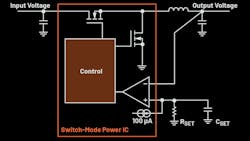
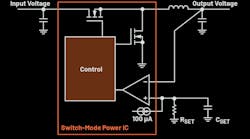
Figure 2 shows the new concept, which employs a unity-gain architecture where the output voltage is fed directly to the error amplifier. The output voltage is adjusted with a resistor (RSET) connected to an internal power source.
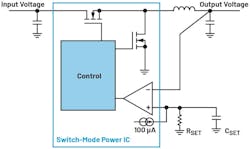
This configuration allows the output voltage to be adjusted down to 0 V. It’s unlike the previous method using a resistor divider shown in Figure 1, where the minimum adjustable output voltage is equal to the potential of the internally installed reference voltage.
Another advantage is the ability to produce less noise at low frequencies below 100 kHz. By incorporating a CSET capacitance, it averages the low-frequency disturbances from the internal current source, substantially reducing these interferences.
In this new architecture, the resistors of the resistor divider don’t introduce additional noise, making the noise behavior largely independent of the output voltage. Consequently, the low-frequency noise doesn’t increase with higher output voltages.
Silent Switcher Step-Down Regulator Example
Many of Analog Devices’ ultra-low-noise linear regulators, such as the LT3045 20-V, 500-mA LDO regulator, use this loop-regulation technology. New step-down switching regulators from the third-generation Silent Switcher family, such as the LTC8625S, are also designed using this innovative approach.
Figure 3 shows the LT8625S modeled using the simulation program LTspice. This switch-mode power converter supports an input voltage of up to 18 V and can be operated with a load current of up to 8 A. It produces a low-frequency noise of 4 μV RMS between 10 Hz and 100 kHz on the output voltage. In addition, it has a built-in precision current source with an accuracy of ±0.8% over the entire allowable temperature range of –40 to +125°C.
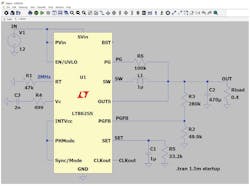
In the circuit in Figure 3, the output voltage is set using resistor R5 on the SET pin. It’s important to note the presence of a resistor divider, composed of R3 and R2, between the output voltage and the PGFB pin. This resistor divider doesn’t influence the control loop, but it’s only used to operate the PG pin.
The design shifts from traditional and established methods like using a resistor divider in a control loop to more modern techniques such as unity-gain architecture. This advance allows for the generation of significantly lower noise levels in the low frequency range. Moreover, the minimal noise that remains isn’t dependent on the set output voltage, enabling the creation of very low voltages down to 0 V. Many new linear regulators as well as switching regulators use this innovation.
>>Download the PDF of this article
683432fig02_promoAbout the Author
 Frederik Dostal
Frederik Dostal
Power-Management Technical Expert
Frederik Dostal is a power-management expert with more than 20 years of experience in this industry. After his studies of microelectronics at the University of Erlangen, Germany, he joined National Semiconductor in 2001, where he worked as a field applications engineer, gaining a lot of experience in implementing power-management solutions in customer projects. During his time at National, he also spent four years in Phoenix, Arizona (USA), working on switch-mode power supplies as an applications engineer.
In 2009, he joined Analog Devices, where since then he held a variety of positions working for the product line and European technical support, and currently brings in his broad design and application knowledge as a power-management expert. Frederik works in the ADI office in Munich, Germany.
Also check out my:
Comment About the Article
To join the conversation, and become an exclusive member of Electronic Design, create an account today!
 Leaders Logo
Leaders relevant to this article: