Phone Museum Offers a Trans-Temporal Tapestry of Telephonic Tech
What you'll learn:
- The Telephone Museum’s collection includes examples of telephone handsets, manual switchboards, and automated exchange equipment that spans most of the industry’s 130-plus-year history.
- Many of the exhibits are hands-on, giving visitors a chance to experience what it was like to be behind the scenes of a telephone exchange.
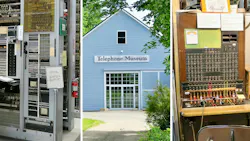
The Telephone Museum might not fit neatly into your must-see list of Maine’s scenic coastlines, quaint villages, and local seafood spots (Fig. 1). However, its blend of technology, history, and culture makes it a great place to visit for tech-nerds and their tech-challenged companions.
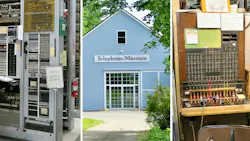
Tucked away off US 1A, between Bangor and Ellsworth, the only clue to its existence is a tiny sign saying “Telephone Museum” tacked to a tree on the corner of a quiet side road. If you go about a mile, you’ll arrive at the modest metal barn that houses a range of telephonic technology and memorabilia.
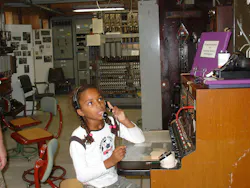
The museum’s collection includes examples of telephone handsets, manual switchboards, and automated exchange equipment that spans most of the industry’s 130-plus-year history. Friendly docents, mostly retired phone-company workers, are on hand to show you how to run the manual plug boards used by early phone-system operators to connect calls (Fig. 2).
This is one of the few places in the world where you can still see banks of the 100-plus-year-old Strowger-style rotary relay switches clattering away as they use the pulses generated by a caller’s dial to automatically connect to another caller’s phone (Fig. 3).
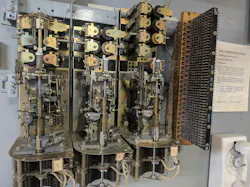
Nearby, you can explore the inner workings of several generations of dial-operated electromechanical switches that began to enter service at the dawn of the 20th century. This includes a room-sized segment of a “modern” 1950s-era crossbar switch, capable of handling a small city’s worth of phone traffic (Fig. 4). You can also see elements of an early Electronic Switching System (ESS), which helped usher in the networks’ transition to transistorized, digitally controlled calling beginning in the late 1960s.
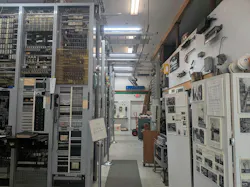
Intended to be a hands-on experience, most of the equipment on display is operational and interconnected by a network created by the museum’s volunteers. This allows curious visitors to make calls across time. They can use antique plugboards and banks of switch relays to patch together a call between an 1870s era wooden-bodied handset and a sleek touch-tone phone from the late 20th century (Fig. 5).
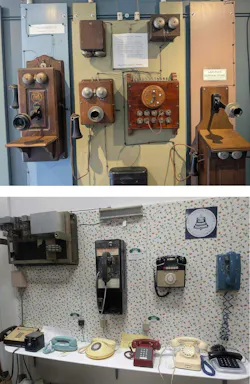
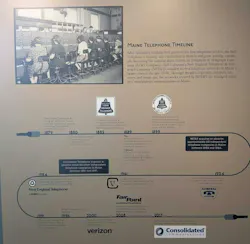
For the historically curious visitor, the visitor center’s timeline carefully curates exhibits that portray the evolution of telephony in Maine and explains how it affected the state’s social and economic development from 1889 to modern times.
The collections of stories, photos, artifacts, and documents begin with the small isolated private telephone networks which were originally built to connect a few of an area’s major hotels, businesses and other institutions. They illustrate how over 60 independent operators emerged and grew to cover different areas of Maine before most of them were acquired or absorbed into what became the New England AT&T network (Fig. 6).
Nostalgia fans and antique buffs will enjoy the collections of artifacts from bygone eras as well as displays of telephone-related souvenirs, memorabilia, and ephemera (Fig. 7).

The Telephone Museum is located at 166 Winkumpaugh Road, Ellsworth, Maine (Google map). Admission is $10 per adult, $5 per child. Ask about discounts for seniors and groups of 10 or more. Additional information is available at the museum’s website or its Facebook home page.
The only downside of this roadside attraction is that it’s only open July through September on Saturdays from 10 a.m. to 4 p.m. Visits on other days can be made by appointment, but if you’re planning on visiting on a different day or with a large group, they request that you schedule the trip well in advance by contacting them at [email protected] or 207-667-9491. Include your name, phone or email, and the number of people in your party.
About the Author
 Lee Goldberg
Lee Goldberg
Contributing Editor
Lee is the author of the popular PowerBites series.
Lee Goldberg is a self-identified “Recovering Engineer,” Maker/Hacker, Green-Tech Maven, Aviator, Gadfly, and Geek Dad. He spent the first 18 years of his career helping design microprocessors, embedded systems, renewable energy applications, and the occasional interplanetary spacecraft. After trading his ‘scope and soldering iron for a keyboard and a second career as a tech journalist, he’s spent the next two decades at several print and online engineering publications.
Lee’s current focus is power electronics, especially the technologies involved with energy efficiency, energy management, and renewable energy. This dovetails with his coverage of sustainable technologies and various environmental and social issues within the engineering community that he began in 1996. Lee also covers 3D printers, open-source hardware, and other Maker/Hacker technologies.
Lee holds a BSEE in Electrical Engineering from Thomas Edison College, and participated in a colloquium on technology, society, and the environment at Goddard College’s Institute for Social Ecology. His book, “Green Electronics/Green Bottom Line - A Commonsense Guide To Environmentally Responsible Engineering and Management,” was published by Newnes Press.
Lee, his wife Catherine, and his daughter Anwyn currently reside in the outskirts of Princeton N.J., where they masquerade as a typical suburban family.
Comment About the Article
To join the conversation, and become an exclusive member of Electronic Design, create an account today!
 Leaders Logo
Leaders relevant to this article: