PCIe 6.0 is moving from specification into formal compliance, raising the bar for receiver validation. As testing advances, engineering teams need repeatable workflows that account for tighter PAM4 margins, precise calibration, backchannel optimization, and link equalization.
PCI Express has steadily doubled bandwidth while preserving backward compatibility, making it the default high-speed interconnect across servers, storage, accelerators, networking, embedded systems, AI, and high-performance computing. But PCIe 6.0 is far more than another speed increase. As compliance activity accelerates, the shift to 64 GT/s PAM4 signaling, FLIT-based encoding, forward error correction, and updated link behavior fundamentally changes what engineers must prove during electrical validation.
For receiver compliance, the margin is tighter, the test flow is more intricate, and the setup itself can create apparent failures if it is not meticulously calibrated. What was once a straightforward receiver test now demands rigorous fixture characterization, TP3 and TP2 stress-eye calibration, and backchannel optimization.
PAM4 Transforms the Receiver Test Problem
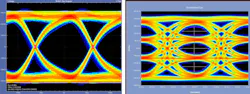
NRZ vs. PAM4 eye diagram comparison
Side-by-side visual showing one NRZ eye versus three smaller PAM4 eyes, with reduced vertical margin highlighted.
The most consequential change in PCIe 6.0 is the move from NRZ to PAM4 signaling. PAM4 carries two bits per symbol across four voltage levels, doubling the data rate while keeping the Nyquist frequency in the same range as PCIe 5.0. That architectural advantage comes at a steep cost: smaller vertical eye openings and roughly 9.5 dB less signal-to-noise ratio than NRZ.
That reduced margin affects the entire receiver test process. Instead of calibrating a single NRZ eye, engineers must work with three PAM4 eyes, often focusing on the top eye as the worst-case condition. Even small variations in amplitude, jitter, channel loss, equalization, connectors, or fixture characterization can push a stressed eye out of tolerance or produce misleading results.
PCIe 6.0 also introduces FLIT-based encoding, lightweight forward error correction, and CRC, shifting receiver evaluation from raw BER toward FLIT bit error rate, or FBER. Compliance testing must demonstrate that the receiver can establish and maintain a link under a specification-defined stressed signal while meeting the required criterion.
Receiver Compliance Is a Rigorous Two-Phase Process
PCIe 6.0 receiver compliance comprises two major phases. First, the stressed signal is carefully calibrated. Second, that calibrated signal drives link equalization and testing to determine whether the receiver can operate reliably under worst-case conditions.
The stress recipe includes transmitter amplitude, random and sinusoidal jitter, differential-mode & common-mode interferences, and inter-symbol interference. The goal is a precisely controlled stressed eye that matches the specification and enables meaningful pass/fail decisions.
Calibration typically begins with short-channel TP3 calibration, then proceeds to TP2 calibration through a lossy channel. TP3 establishes characteristics such as amplitude, transmitter equalization presets, random jitter and sinusoidal jitter. TP2 adds the channel, package model, and reference receiver behavior, then uses simulation and measurement to create the final stressed-eye recipe. For PCIe 6.0 CEM testing, total channel loss must be thoroughly understood and tightly controlled within a narrow range at the Nyquist frequency.
Fixture Characterization Is No Longer Optimal in Practice
Fixture characterization is foundational. The path includes RF cables and connectors, CEM compliance load board and baseboard, variable ISI, and package embedding. Each element contributes insertion loss and discontinuities that directly affect calibration convergence and receiver results.
Because PAM4 sharply reduces noise margin, even minor uncertainty in the channel budget can have outsized effects. VNA-based characterization helps confirm that the physical channel aligns with the intended insertion-loss range. If cables, fixtures, or hardware configurations change, calibration should be repeated rather than reused.
Basic lab discipline matters even more at 64 GT/s: warm up and calibrate instruments, properly torque coaxial cables, fully seat miniature connectors, and match software versions to the recommended compliance environment. At PCIe 6.0 margins, these seemingly minor details can determine whether calibration converges, or engineers chase a false failure.
Backchannel Optimization Comes Before Meaningful Receiver Testing
Receiver link equalization is a two-way negotiation. The BERT drives the calibrated stressed signal into the DUT receiver while the DUT transmitter returns a signal to the BERT receiver through the fixture. That return path is the backchannel.
If the BERT cannot reliably recover the DUT’s transmitted signal over the backchannel, link training may fail or produce inconsistent results. The receiver test then reflects a compromised setup rather than the true DUT receiver capability.
The practical sequence is to connect the DUT transmitter to the BERT, place the DUT in a loopback condition, run the BERT receiver equalization sweep, and verify that return-path BER is below the required threshold of 1E-6 before Rx LEQ testing.
Backchannel optimization is inherently device-specific. Different DUTs can present different transmitter behavior and return-path conditions, so optimized BERT receiver settings must be established per device. Automation helps remove operator dependency and gives each receiver test a clean, consistent starting point.
Transmitter LEQ Verifies the Other Half of the Negotiation
Transmitter link equalization verifies how the DUT transmitter behaves after link training requests. In PCIe 6.0, link partners exchange preset requests and acknowledgments until each receiver sees a usable PAM4 eye. The test confirms that the transmitter can produce requested equalization settings accurately and respond quickly enough to maintain a stable link.
For add-in cards, initial transmitter equalization confirms that the first post-training preset aligns with expectations. Response-time testing, required for both add-in card and system testing, measures how long the device takes to respond to a preset change—which must be less than one microsecond, with the resulting preset also required to meet tolerance.
PAM4 makes this step considerably more demanding because preset tolerances are far tighter than in previous NRZ generations—plus or minus 0.5 dB for most presets. That intensifies the need for a high-bandwidth real-time oscilloscope, accurate fixture characterization and calibration, and synchronized control between the BERT and oscilloscope.
Receiver LEQ Brings the Flow Together
Receiver link equalization is the final proof point. The DUT receiver is driven by the calibrated stressed eye while negotiating equalization with the BERT as link partner. Once the DUT reaches the target data rate and enters loopback mode, the test applies stress and measures FBER over the defined interval.
This is where the shift from raw BER to FBER proves critical. PAM4 can produce burst error behavior, and FBER far better reflects how FEC handles those errors. The receiver test criterion is an FBER of 1E-6 or better within the defined measurement window.
Debug Starts by Separating Setup Problems from DUT Problems
When receiver testing fails, the DUT is not always the root cause. PCIe 6.0 measurements are sensitive enough that fixtures, cables, backchannel settings, software configuration, and calibration files can all create symptoms that look like genuine receiver failure.
A structured approach starts with link training. If the link cannot train even at low data rates, suspect connectivity problems such as damaged cables, poor connector seating, or fixture issues. If the link trains only at lower rates, likely causes include equalization mismatch, insufficient backchannel optimization, or configuration problems. If link training succeeds but FBER is abnormal, error patterns can point to equalizer mismatch, clock-data recovery or margin limitations, or lane-specific implementation issues.
Advanced analysis can help separate setup issues from silicon behavior. FEC error distribution, PAM4 symbol transition analysis, MSB/LSB comparison, and error-location analysis can reveal whether errors cluster by symbol transition, lane, sequence, or FEC group.
Automation Becomes a Requirement for Repeatability
PCIe 6.0 receiver compliance can be executed manually in principle, but the complexity and number of interdependent steps make manual workflows difficult to scale and difficult to reproduce consistently. Calibration requires precise coordination among the BERT, oscilloscope, analysis software, simulation tools, fixtures, stress settings, backchannel optimization, and reporting processes. Each manual transition consumes engineering time and introduces opportunities for operator error, configuration mismatch, or undocumented variation that can reduce measurement confidence.
As a result, automation is becoming an essential element of PCIe 6.0 validation rather than simply a productivity enhancement. Automated workflows help enforce the correct sequence of setup, calibration, and compliance testing; maintain consistent instrument control across multiple platforms; and preserve traceability by capturing calibration files, software versions, test configurations, measurement results, and reports. This improves repeatability, accelerates debug, and allows engineering teams to focus on device performance rather than test setup management.
As validation workflows increasingly span both calibrated signal generation and waveform analysis, automation also plays a critical role in coordinating the BERT and oscilloscope as a unified test system. That coordination can reduce setup effort while improving consistency across calibration, transmitter link equalization verification, and receiver link equalization validation.
Best Practices for PCIe 6.0 Receiver Compliance
Engineers should warm up and calibrate instruments, characterize fixtures and cables with a VNA, avoid reusing TP3 calibration after hardware changes, confirm a stable TP3 result before TP2 calibration, optimize the backchannel for each DUT, maintain rigorous software-version traceability, and automate calibration and test execution wherever possible.
The Takeaway
PCIe 6.0 delivers the bandwidth demanded by AI, machine learning, high-performance computing, storage, and next-generation networking, but it also fundamentally changes the economics of validation. With PAM4, the margin is smaller. With FEC and FLIT-based behavior, the error model is different. With link equalization, the receiver test depends on both the forward stressed signal and the return backchannel.
For engineering teams, the path to compliance is not simply more measurement. It is better-controlled measurement. Accurate fixture characterization, disciplined stress-eye calibration, verified backchannel optimization, automated Tx and Rx LEQ workflows, and structured debug are now central to successful PCIe 6.0 receiver validation.
In short, PCIe 6.0 receiver compliance is a precision workflow. Teams that treat calibration and automation as integral to the test—not merely preparation for it—will be far better positioned to achieve repeatable results, diagnose failures quickly, and move designs through compliance with confidence.
For a deeper dive into PCIe 6.0 receiver calibration, backchannel optimization, and Tx/Rx link equalization testing, watch the on-demand webinar: Inside PCIe 6.0 Receiver Calibration & LEQ Testing | Electronic Design.