MEMS Sensors Bring New Precision to Sports Analytics
What you’ll learn:
- How accelerometers, gyroscopes, and IMUs quantify motion in balls, wearables, and sports equipment.
- Why high-range MEMS sensors and sensor fusion matter for fast, impact-heavy athletic motion.
- How sensor data can improve training, officiating, safety, analytics, and fan understanding.
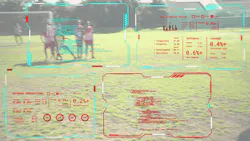
Elite sport isn’t only measured in goals, birdies, and trophies, but in milliseconds, degrees, acceleration, spin, and position. In the 2026 FIFA World Cup, we saw how sports performance data took center stage when a sensor-enabled ball detected the slightest touch, which canceled out a goal by Croatia, leaving Portugal with a 2-1 win in Toronto.
And sports data isn’t limited to soccer — sensors played a role in the U.S. Open at Shinnecock Hills, the U.S. Women’s Open at Riviera Country Club, and now in Major League Baseball (Fig. 1).
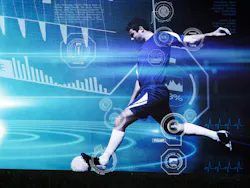
While each contest is decided by human skill under pressure, the ability to understand that skill is increasingly important to success. Microelectromechanical-systems (MEMS) sensors that integrate tiny mechanical structures and electronic circuits on silicon into a ball, club, wearable, or piece of training equipment are key to driving tomorrow’s biggest victories.
MEMS Sensors Take to the Field
Among the most common MEMS sensors in sport are accelerometers, which measure linear acceleration and impact events, and gyroscopes, which measure angular velocity. Combined in an inertial measurement unit, or IMU, these sensors can capture how fast an object moves, how quickly it rotates, when impact occurs, and how that motion changes over time (Fig. 2).
At the 2022 World Cup in Qatar, semi-automatic offside technology paired tracking cameras around the stadium with an IMU embedded in the official match ball. The cameras tracked the positions of players and the ball 50 times per second, while the ball’s IMU detected acceleration and angular velocity 500 times per second.
By identifying the exact moment that the ball was kicked and synchronizing that timestamp with player-position data, the system helped create a 3D reconstruction for offside review. The referee remained the final authority on the call, but when a fraction of a second makes all the difference, embedded sensing can add information that even the trained eyes of the best officials can’t reliably provide.
Bringing Technology and Data Together to Drive Results
By combining what cameras track from the outside with what MEMS sensors can physically measure in sports applications, a sensor embedded in a ball is able to detect impact, spin, and direction changes. A sensor in a wearable can track acceleration, workload, and body position. A sensor in a bat, racket, club, helmet, shoe, or training device captures motion from the athlete’s perspective.
An example is the G-GRIP golf club by SGLAB, which embeds TDK sensors in the shaft and grip for AI-powered intelligence. When sports gear is equipped with sensors, the result is a more complete picture of performance, one that connects visible outcomes with the mechanics producing them.
Training with the MEMS Advantage
Performance and abilities that coaches have always evaluated by eye or basic measurement can now add a repeatable measurement layer with sensors. By measuring fast, complex movement in compact, low-power packages, MEMS sensors deliver robust data on a sprinter’s stride, a soccer star’s corner kick, a tennis player’s serve, a basketball player’s leaping ability, and a golfer’s downswing.
All of these motions involve rapid changes in speed, direction, and rotation. Instead of saying a swing looked late, a pass looked rushed, or a landing looked unstable, sensor data can help quantify timing, impact, rotation, acceleration, and consistency.
Connected sports equipment and training systems are already being used to measure performance and refine techniques. From smart helmets with impact detection, to connected clubs, bats, and rackets for swing analytics, motion-based coaching systems help elite athletes reach new levels of peak performance.
MEMS Peace of Mind
Legendary golfer Arnold Palmer once said “Golf is a game of inches. The most important are the six inches between your ears.” The depth of information from MEMS sensors can help golfers understand their game even better, giving them the confidence they need to play their game.
For example, at the recent Men’s U.S. Open and The Open Championship, control was more important than raw power. Shinnecock Hills is built for the elements, with routing that uses natural features and prevailing wind to create a variety of shot-making challenges. Meanwhile, Royal Birkdale is a classic links test where accuracy, bunkers, firm turf, and wind can turn small errors into large consequences. In these conditions, the difference between a controlled fade and a shot drifting into trouble may begin with small changes in club path, face angle, rotation, tempo, or impact timing.
This makes sensors in golf club training tools especially relevant. In a high-speed rotational event like a golf swing, the club changes direction at transition, accelerates through the downswing, rotates into impact, and decelerates through the follow-through. A MEMS sensor placed in a training club, grip, shaft module, or attached analyzer can capture motion throughout that sequence. This data can help a coach see changes in tempo, clubhead rotation, and consistency from swing to swing to rack how a player’s motion shifts with a different club, shaft, setup, or shot shape.
The Demanding Engineering Requirements of Athletics
Sports motions can exceed the dynamic range of conventional motion sensors, particularly near impact or during high-speed rotation. Golf and tennis swing analysis, soccer ball kicks, and basketball activities are fast, impact-heavy events that can exceed the ±2,000-degrees-per-second (dps) full-scale range of conventional gyroscopes and ±16g range of accelerometers. Sports sensors therefore need sufficient measurement range to keep capturing data when motion reaches its peak speed or impact.
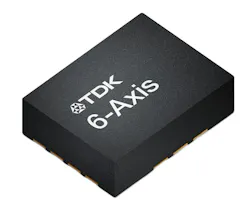
By extending that range, motion sensors can avoid saturation during critical moments and provide continuous data before, during, and after impact. Those high-impact and high-speed applications helped drive the development of the TDK InvenSense’s ICM-45686, a wide-range 6-axis MotionTracking device for high-impact applications like sports. Its gyroscope supports measurement ranges up to ±4,000 dps, while its accelerometer supports up to ±32g.
The strongest use cases for MEMS sensors in sports training deliver data when distinction matters. Capturing the full motion profile does this, giving sports-analysis systems better data from which to evaluate technique and performance. The Rules of Golf indicate that success should depend on a player’s judgment, skills, and abilities. MEMS-enabled clubs and analyzers can improve training, fitting, and practice to amplify a player‘s judgement.
Sensor Fusion and Sports Analytics
Motion data becomes more useful when it’s combined with other tools. For instance, MEMS microphones can support voice commands, coaching interfaces, communication, and acoustic event detection. Ultrasonic time-of-flight sensors can provide distance, presence, proximity, and gesture information.
Imagine getting immediate feedback with technical precision and how quickly that could improve a nagging issue with an athlete’s form. Combining motion data from an athlete, orientation data from equipment, proximity data from the surrounding space, and audio input from coaching systems can work together to create a richer picture of what’s happening (Fig. 3).
Actionable Insight Matters More than Endless Data
More raw numbers can overwhelm athletes and coaches. The goal is better-contextualized information that’s accurate, timely, and easy to act on. A useful system should help answer practical questions, like “Did the athlete compensate due to fatigue?” “Did an equipment change help improve consistency?” “Did the player use the equipment the way the coach intended?”
Sports sensors must be small enough not to affect performance, rugged enough to survive impact and vibration, and power-efficient enough for continuous or event-triggered use. This puts as much pressure on engineering as it does on analytics. Sensor placement, sampling rate, calibration, dynamic range, wireless performance, mechanical integration, and algorithms all affect the quality of the final insight.
In a laboratory, a signal may be clean. On a field, course, court, or training ground, the system must handle sweat, weather, shock, temperature changes, body movement, and imperfect usage. Only then can the system provide the type of actionable insight that boosts performance.
Can AI Sense What You Sense?
While much of sport can be more easily quantified in metrics like speed and distance, it’s the human element that may seem intangible. Whether it’s referred to as “feel,” “touch,” or “trusting your gut,” these fine-tuned motions are subtle, with the human brain constantly reacting to stimuli to achieve them.
Smaller, better MEMS sensors make it more possible to understand the nuance of athletes’ skill with more precise tracking of these motions. When AI can feel what an athlete feels, it can add data to what seems impossible to express, making it easier to explain and recreate.
MEMS Makes the Invisible Visible for Fans, and More
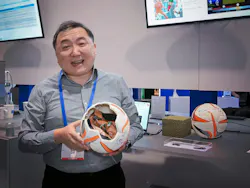
Helping fans better understand a sport is a great way to grow any game, and MEMS-powered broadcast-explanation tools can boost sportscaster analysis. Broadcasts already use tracking data to make positioning, speed, and tactics more visible. Sensor data can add more insight around the instant of contact, the rotation of a ball, the force of an impact, or the motion pattern behind a decisive play (Fig. 4).

This, in turn, can increase a fan’s understanding — and appreciation — of how impressively pro athletes train. A World Cup viewer may better understand the difficulty of putting spin on a shot. A golf viewer can gain new appreciation of the decision-making that helps a one shot hold its line into a crosswind. Sports fans love a good debate, and more information in today’s data-driven world gives die-hards more nuance to discuss, driving an entire sub-industry of sports communities on social media.
And, of course, in sports like football or hockey, MEMS-based impact sensing can contribute to athlete-safety programs by helping quantify impact events, while still leaving medical assessment and return-to-play decisions to qualified professionals. Not to mention, the data could lead to more protective equipment in the long term.
Accelerating the Future of Sports Analytics
Modern MEMS sensors help fans and athletes alike better understand the pressure, preparation, instinct, talent, and unpredictability of competition. They change how performance can be measured, making elite movement more visible. Plus, sensors in sports and fitness applications could also lead to greater player safety because of advanced detection capabilities to identify shocks, impact, or abnormal motion.
As sports move deeper into the data era, technologies such as MEMS IMUs, microphones, and ultrasonic time-of-flight sensors, such as those developed by InvenSense, a TDK group company, can help turn motion, sound, and spatial awareness into trusted insight. They put engineers at the center of tools that support athletes, coaches, officials, and fans without taking the human element out of sport.
>>Download the PDF of this article
 dreamstime_wavebreakmedialtd_415491228
About the Author
Song Li
Product Marketing Director. TDK InvenSense
Song Li is Product Marketing Director at TDK InvenSense. He over 20 years of experience in the semiconductor industry with positions in marketing, applications and sales. Experienced in product lifecycle management and MEMS product development, Song has a strong understanding of consumer and embedded product development cycle and ecosystem.
He earned an MSEE from the University of Alabama at Birmingham and a BSEE from Tsinghua University.
Comment About the Article
To join the conversation, and become an exclusive member of Electronic Design, create an account today!
 Leaders Logo
Leaders relevant to this article: