Chips, Boards, and Modules at Embedded World North America 2026
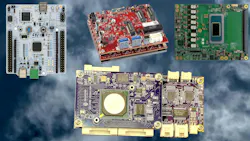
This year’s Embedded World North America was a bit bigger this year, with plenty of new hardware and software along with the usual mix of artificial-intelligence highlights. In this roundup, I look at some of the latest hardware items at the show.
The boards in this mix are designed for rugged applications, making them more expensive but more reliable. The modules will require a carrier board where custom options are normally added. There’s movement toward higher-speed Ethernet ports with time-sensitive networking (TSN). M.2 slots are also the norm for peripheral expansion as well as support for NVMe SSDs and AI accelerators. AI-enabled processors have become more common, too.
Table of Contents
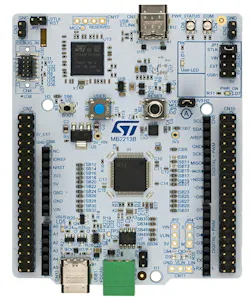
STMicroelectronics’ STM32C5 microcontroller is based on a 144-MHz Arm Cortex-M33 core. It includes 1 MB of flash memory, 256 kB of RAM, 64 kB of data flash, and 4.5K of one-time programmable (OTP) memory. And there’s a floating-point unit (FPU) along with a CORDIC math processor for trigonometric function acceleration.
The low-cost chip is also a low-power microcontroller with a dynamic power consumption under 80 µA/MHz. An integrated, 1% calibrated, RC oscillator across −20 to 105°C temperature reduces system BOM and is available in packages as small as 3 × 3 mm.
The chip supports 10/100 Ethernet along with a pair of FD-CAN interfaces, USB 2.0 host/device, and octal SPI that works with HyperFlash and HyperRAM. One I3C port and two I2C ports are in the mix. The three 12-bit ADCs support up to 30 channels at 2.25 MSPS or 4.5 MSPS in dual interleaved mode. There’s a single 12-bit DAC and a comparator.
The security system includes a pair of AES coprocessors with differential power analysis (DPA) resistance. Accelerators handle hash functions and public keys, plus there’s a true random number generator and a 96-bit unique ID.
The STM32C5 Nucleo board hosts an STM32C. The board includes Arduino Uno V3 headers as well as ST Morpho headers. The processor is supported by ST’s STM32Cube IDE and ecosystem.
More Embedded World North America Content
 Anaheim Convention Center
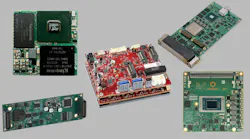 collage of boards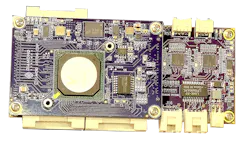
Diamond Systems’ EPS-12002C Managed Ethernet Switch is designed for rugged environments, including transportation applications. Equipped with up to two 2.5G ports and eight or twelve 1G ports, it’s designed to work with a heatsink or heat spreader. The EPS-12002L adds support for 10 G SFP+ sockets.
The module, which is a Layer 2+ switch, also handles Layer 3 routing and switching. It includes IEEE-1588 precision time protocol support. Configuration is via an RS-232 port. The switch works over −40 to +85°C operating temperature ranges. All connectors are latching I/O connectors that meet MIL-STD-202G shock/vibration resistance. The system can run off voltages from 5 to 36 V. GUI-based configuration software is provided.
SECO SOM-COMe-BT6-PTL COM Express Module
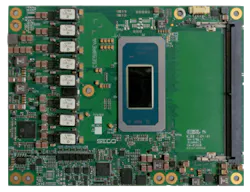
SECO provides an array of COM Express modules. COM Express Type 6 is one of these compact form factors. The SOM-COMe-BT6-PTL is a COM Express Type 6 board that supports Intel’s Core Ultra Series 3 (code name Panther Lake-H) processors of AI-enabled processors. The Intel GPU has a dozen Xe cores that can provide up to 180 TOPS while the low-power NPU delivers 50 TOPS.
The module has a pair of DDR5 SO-DIMM slots that handle up to 96 GB with DDR5-5600 modules. It exposes 20 PCI Express lanes, eight high-speed USB ports, four 10-Gb/s Superspeed ports, and a pair of 40-Gb/s USB 4 ports. A 2.5G Ethernet port supports time-sensitive networking (TSN). It’s possible to order a soldered 1 TB NVMe SSD.
The module can run operating systems like Linux, including SECO’s own Clea OS. It also works with Windows 10 IoT Enterprise.
VersaLogic Raptor
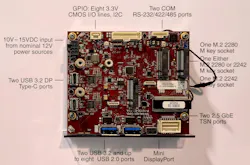
VersaLogic’s Raptor is an 80- × 95-mm COM-HPC Mini, single-board computer (SBC) that meets MIL-STD-202H shock and vibration standards. It has a pair of M.2 2242 and a 2280 slots. The board comes with an Intel U300e featuring Intel UHD Graphics or a Core i5-1345URE with Iris Xe graphics.
On the communication side, it sports a pair of 2.5G Ethernet ports that are magnetically isolated and with latching sockets. The Ethernet ports also support time-sensitive networking (TSN). The USB ports include eight 2.0, two 3.2, and two 4.0. There are two serial ports, too. An ADC and CAN bus support is possible via the M.2 M key slots.
About the Author
 William G. Wong
William G. Wong
Senior Content Director - Electronic Design and Microwaves & RF
I am Editor of Electronic Design focusing on embedded, software, and systems. As Senior Content Director, I also manage Microwaves & RF and I work with a great team of editors to provide engineers, programmers, developers and technical managers with interesting and useful articles and videos on a regular basis. Check out our free newsletters to see the latest content.
You can send press releases for new products for possible coverage on the website. I am also interested in receiving contributed articles for publishing on our website. Use our template and send to me along with a signed release form.
Check out my blog, AltEmbedded on Electronic Design, as well as his latest articles on this site that are listed below.
You can visit my social media via these links:
- AltEmbedded on Electronic Design
- Bill Wong on Facebook
- @AltEmbedded on Twitter
- Bill Wong on LinkedIn
I earned a Bachelor of Electrical Engineering at the Georgia Institute of Technology and a Masters in Computer Science from Rutgers University. I still do a bit of programming using everything from C and C++ to Rust and Ada/SPARK. I do a bit of PHP programming for Drupal websites. I have posted a few Drupal modules.
I still get a hand on software and electronic hardware. Some of this can be found on our Kit Close-Up video series. You can also see me on many of our TechXchange Talk videos. I am interested in a range of projects from robotics to artificial intelligence.