New Research Shows Scandium Doping Can Boost Sodium-Ion Battery Life
A new report from Tokyo University of Science in Japan reveals how new materials can dramatically improve the durability and performance of sodium-ion batteries (SIBs) through two distinct mechanisms—bulk doping and surface coating.
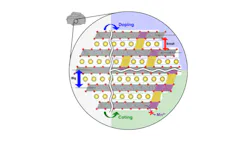
A research team led by Professor Shinichi Komaba and Associate Professor Shinichi Kumakura from the Department of Applied Chemistry at Tokyo University of Science investigated how incorporating scandium, specifically Sc3+ , into cathodes based on a sodium-ion chemistry called NNMO. The study showed scandium doping can stabilize the battery's bulk crystal structure, while scandium coating can suppress surface degradation, offering two complementary strategies for boosting battery life and performance (Fig. 1).
Tests revealed that scandium modification dramatically improved capacity retention after 100 charge-discharge cycles from 18.6% for undoped electrodes to 67.8% with scandium doping and 75.4% with scandium coating. The other highlight is that, in full sodium-ion cells, the scandium-coated cathode retained 91.2% of its initial capacity after 300 cycles, representing a substantial improvement in long-term battery durability, the team said.
The research could be a boon to battery manufacturers, giving them a way to supply lower-cost, longer-lived SIB cells. Part of SIB's rising popularity is due to the much greater abundance of sodium compared to lithium. As a result, SIBs offer the potential to provide much lower cost per kW/h of capacity relative to today's lithium-ion (Li-ion) batteries. In addition, SIBs could also offer better safety and low-temperature performance.
While it’s still early, SIBs are already being commercialized in stationary, grid-connected battery energy storage systems (BESSs) and backup power applications, where they probably have the best of chance of beating Li-ion batteries. They are also breaking through in applications ranging from portable electronics to electric vehicles (EVs).
The report, titled "Scandium doping and coating for improving O3-NaNi1/2Mn1/2O2 electrode in sodium battery,” was published in “Small”. a journal for micro/nano-technology, which can be accessed at this link: 10.1002/smll.75049.
About the Author
 Lee Goldberg
Contributing Editor
Lee is the author of the popular PowerBites series.
Lee Goldberg is a self-identified “Recovering Engineer,” Maker/Hacker, Green-Tech Maven, Aviator, Gadfly, and Geek Dad. He spent the first 18 years of his career helping design microprocessors, embedded systems, renewable energy applications, and the occasional interplanetary spacecraft. After trading his ‘scope and soldering iron for a keyboard and a second career as a tech journalist, he’s spent the next two decades at several print and online engineering publications.
Lee’s current focus is power electronics, especially the technologies involved with energy efficiency, energy management, and renewable energy. This dovetails with his coverage of sustainable technologies and various environmental and social issues within the engineering community that he began in 1996. Lee also covers 3D printers, open-source hardware, and other Maker/Hacker technologies.
Lee holds a BSEE in Electrical Engineering from Thomas Edison College, and participated in a colloquium on technology, society, and the environment at Goddard College’s Institute for Social Ecology. His book, “Green Electronics/Green Bottom Line - A Commonsense Guide To Environmentally Responsible Engineering and Management,” was published by Newnes Press.
Lee, his wife Catherine, and his daughter Anwyn currently reside in the outskirts of Princeton N.J., where they masquerade as a typical suburban family.


Comment About the Article
To join the conversation, and become an exclusive member of Electronic Design, create an account today!
 Leaders Logo
Leaders relevant to this article: