Validate AI Data Center Power Supplies via Electronic-Load Emulation
What you'll learn:
- Why AI data centers are moving from 48-V to 800-V DC power architectures.
- How dynamic load testing helps validate AI power supplies under real-world workloads.
- The challenges that GPUs create for power delivery, efficiency, and thermal management.
Data centers face a dual power challenge: Delivering enough power to increasingly dense compute racks and responding fast enough to the rapid load transients created by GPUs and other AI accelerators.
"You can think of a GPU as several high-performance computing channels all working in parallel," said James Hitchcock, vice president, general manager, and managing director of Tektronix's EA Elektro-Automatik division. "When a compute rack is prompted, it can draw extremely high currents in very short time periods. This rapid power consumption creates several challenges for engineers," he said, citing the excessive heat and the large amounts of heavy, expensive copper to handle such high currents.
To reduce these ultra-high currents along with the power losses and heat that come with them, NVIDIA and most of the top hyperscalers are all looking to adopt 800-V DC power architectures, said Hitchcock.
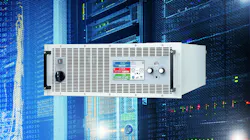
He added that designing power supplies for these situations requires engineers to balance high currents, high voltages, and high speeds, and testing these systems can be equally challenging. To tackle all three of these demands, Tektronix recently introduced its EA ELR 21000 Dynamic Test System, which allows engineers to validate power supplies and other systems destined for 800-V DC architectures.
Hitchcock said it combines high-dynamic load emulation with energy regeneration, giving engineers the ability to test everything from individual power-supply units (PSUs) to power "sidecars" under realistic AI-driven load conditions. By emulating the power consumption patterns of GPUs, CPUs, and other hardware inside the rack, the ELR 21000 can recreate the sharp power spikes characteristic of AI workloads.
The EA Dynamic Test System can scale from 30 kW with a single ELR 21000 to 240 kW by linking up to eight units in parallel. It’s possible to link multiple racks to handle more than a megawatt. The electronic load is set up "to emulate an AI compute system loading an 800-V DC power rack, so engineers can ensure their 800-V power systems are suitable for the large variations in power demand as GPUs cycle during AI computing," said Hitchcock.
Trending Up: High-Voltage DC Power Distribution
The current architecture for inside-the-rack power delivery in AI data centers depends on relatively low-voltage DC power distribution, typically between 48 V — the industry standard for roughly the last decade — and 54 V. While these traditional architectures still dominate, they’re struggling to stay ahead of the power demands of racks packed with GPUs, CPUs, and other ultra-high-current chips like networking switches.
For instance, a single AI server rack consuming 50 kW requires approximately 1,040 A of current at 48 V since power equals voltage times current. Managing that current is very challenging. The busbars, cables, and other conductors running power throughout the rack require more rack space.
And as higher currents flow through the resistance of these copper conductors, they produce significantly higher I²R losses, since power loss equals resistance times current squared. Such losses generate additional heat.
These problems are magnified by the rising power demands of AI. NVIDIA's upcoming Rubin Ultra rack is designed to draw around 600 kW per rack, a massive increase from the 120 kW of power per rack with its Blackwell architecture. At 600 kW, a rack running on 48 V would need roughly 12,500 A of current, which requires even more copper in the form of busbars, cables, and wiring, weighing more than 200 pounds. The resulting I²R losses would also lead to a significant amount of heat, requiring liquid cooling.
To minimize these complexities and inefficiencies, NVIDIA and other AI giants such as Google, Meta, and Microsoft are backing the broader shift to high-voltage DC (HVDC) power distribution, including 800 V DC. Using 800 V, current racing into the compute rack can be significantly reduced, reversing the space, heat, and other penalties that come with 48 V. Lower currents also mean less voltage drop across busbars and other conductors, potentially giving engineers the ability to eliminate some power-conversion stages.
In the short term, the AC-DC power supplies will be relocated into dedicated power racks — referred to as “sidecars” — reclaiming rack space for more GPUs. These sidecars will convert 480 V AC to an 800-V DC bus locally and then use busbars to send it to the main compute rack. Inside the main rack, the 800 V will then be converted to 48 V so that it can be distributed up and down the rack or delivered directly to servers at 800 V before being stepped down by a board-level DC-DC converter.
In the long term, solid-state transformers (SSTs) could be used to convert AC from the grid directly to 800 V DC, feeding the entire AI data center with it and eliminating intermediate AC conversion stages.
While 800-V DC power distribution is still in the early stages of deployment, it’s becoming the new standard for new AI data centers. "800-V DC power infrastructure is already being installed in the newest data centers, and I expect most newly built AI data centers to choose an 800-V DC architecture due to the massive cost and footprint savings," said Hitchcock. "50-V DC power infrastructure will continue to play an important role in existing data center expansion as well as small, standalone compute racks."
HVDC power architectures are already well established in EVs. But bringing them into AI data centers poses a new set of challenges for engineers. As Hitchcock pointed out, power levels are often 10X to 100X higher in data centers than in EVs. Also, GPUs have challenging dynamic load requirements, resulting in transients loads with slew rates of up to 2.5A/μs at the PSU and peak pulses that can reach 160% of nominal power consumption.
These can be difficult conditions to deal with when designing a power supply and testing it. "The challenge is in power density, efficiency, and stability when the AI compute rack powers up to answer a prompt or train a new model," said Hitchcock.
As a result, the EA ELR 21000 and other electronic loads play a major part in helping engineers optimize designs for both efficiency and performance, particularly when combined with power-integrity and analysis tools.
According to Hitchcock, "With next-generation data centers targeting gigawatt scale, every fraction of a percent in efficiency gains converts into significant savings in operating costs both from lower energy usage and lower cooling requirements."
Emulating Entire Racks to Test AI Power Supplies
With a DC voltage range of 0 to 1,000 V and DC output current of up to 5,120 A, Tektronix said its EA Dynamic Test System is well positioned for evaluating compliance with emerging 800-V DC architectures.
Featuring DC output power of up to 1,920 kW, Hitchcock said a single 30-kW unit can be configured for testing individual power supplies. By stacking eight of these units, the ELR 21000 is able to scale up to 240 kW per 42U system. The racks can be connected to deliver up to 1.9 MW, ensuring enough power and performance to emulate multiple AI racks today and megawatt racks in the future. The system uses forced air from front to rear to stay cool, and it comes with optional water-cooling capabilities.
On top of its overall power output, the ELR 21000 provides a fast, high dynamic DC current output to meet the demands of data center power infrastructure, enabling slew rates of up to 1.9A/μs at 30 kW and up to 12 A/μs at 240 kW. Featuring overload capabilities of up to 125% of its nominal power, it can also emulate the sudden bursts in power consumption that occur when AI racks leap to full power. This enables validation of peak power demands without requiring a larger system.
In addition, the system is equipped with an arbitrary function generator (AFG), giving engineers the ability to apply waveforms such as sine, triangle, rectangle, or trapezoid to the voltage or the current. Test sequences can be saved and reloaded when needed, saving time.
Given the dangerously high voltages used by 800-V power architectures, the rack also comes equipped with a two-channel emergency stop system for safe shutdown in emergency situations. The emergency stop button is located on the front door, while the rear door is secured with door contact switches. If the rear door is opened during operation, the emergency stop system is engaged automatically. It has all of the usual overtemperature, overvoltage (OVP), and overcurrent protections (OCP) for electronic loads, too.
Instead of wasting hundreds of kilowatts of electricity on power-supply testing, Tektronix said the ELR 21000 can also act as a regenerative load, returning electricity to the grid with efficiencies of up to 95%.
"We see a clear trend toward increased power levels at the compute rack with testing requirements increasing from hundreds of kilowatts to more than a megawatt in the very near future," said Hitchcock. Because of that, "the Dynamic Test System is fully scalable to meet our customers' needs today and into the future."
About the Author
 James Morra
James Morra
Senior Editor
James Morra is the senior editor for Electronic Design, covering the semiconductor industry and new technology trends, with a focus on power electronics and power management. He also reports on the business behind electrical engineering, including the electronics supply chain. He joined Electronic Design in 2015 and is based in Chicago, Illinois.