Capacitors Snap into AI Server Power Supplies
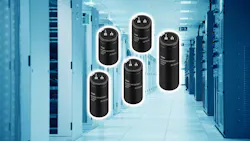
TDK expanded its series of compact snap-in aluminum electrolytic capacitors, targeting AI server power supply units (PSUs) and other high-performance switch-mode power supplies (SMPS).
The capacitors, including the B43645, B43657, B43658, B43659, B43660, and B4366, combine high voltage and capacitance in a space-saving form factor. Featuring diameters from 22 to 35 mm and lengths from 25 to 100 mm, the passives provide a high capacitance-to-volume ratio, which translates to higher power density and improved reliability. Both features are critical for handling the continuous, high-load operation typical in AI data centers.
TDK said its latest Al-Caps come with large capacitances ranging from 80 to 2,060 µF and handle high ripple currents ranging up to 5.39 A. Additionally, it raised the DC voltage rating of the devices up to 500 V. This gives engineers the ability to handle the same DC bus voltage with fewer components while eliminating the need for voltage-balancing circuits, saving PCB space. The added voltage headroom also helps extend capacitor lifetimes and enhances system reliability.
As AI servers cram more computing power per rack, data centers are becoming increasingly hot and crowded. Because excessive heat is one of the leading causes of capacitor failure, durability is a critical factor for power-supply designers.
TDK said its new capacitors are rated for up to 5,000 hours of operation at 105°C, allowing them to handle the heat associated with densely packed AI racks. The snap-in capacitors feature a robust aluminum-can construction, while an integrated pressure-relief mechanism protects them against abnormal operating conditions.
The company noted that the same power-handling properties critical to AI data centers also make the capacitors well-suited for solar inverters and other grid-connected renewable-energy systems.
About the Author
 James Morra
James Morra
Senior Editor
James Morra is the senior editor for Electronic Design, covering the semiconductor industry and new technology trends, with a focus on power electronics and power management. He also reports on the business behind electrical engineering, including the electronics supply chain. He joined Electronic Design in 2015 and is based in Chicago, Illinois.