Multiphase Power Module Supplies AI from Beneath the Board
What you'll learn:
- How Infineon's multiphase power modules bring vertical power to power-hungry systems.
- Benefits and key components of the vertical power modules.
- Current sensing and heat monitoring features.
In data centers, AI chips such as NVIDIA’s GPUs are bordered by massive multiphase DC-DC converters, with current traveling horizontally across the surface of the power transistors and across the circuit board through throngs of inductors and capacitors.
Such lateral power delivery results in higher resistance, leading to higher power losses in the power delivery network (PDN) and slower transient response — on top of the heat involved. These challenges intensify as the current demands of the latest AI chips continue to surge.
But the trend can be reversed to some extent with vertical power delivery (VPD), said George Liang, senior director of system applications engineering at Infineon. The vertical layout relocates the power electronics under the PCB, slinging power above into the processor and shrinking the distance that power needs to travel to the load, thus reducing resistive losses.
In the video above, Infineon highlights its first multiphase power module that’s small enough to enable vertical power in data centers: the TDM2454xx.
The TDM2454xx is the latest product in Infineon’s lineup of data center power solutions. It joins the dual-phase TDM2254xD and TDM2354xD power modules along with discrete power stages, all covered in the video above.
A Vertically Stacked Module for Vertical Power Delivery?
The TDM2454xx comprises four synchronous buck converters, each with a smart power stage embedded inside the package substrate. The power inductor is mounted on top of the module, which comes with fully integrated decoupling capacitors (Fig. 1).
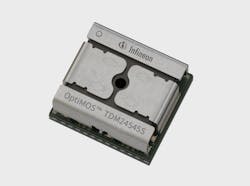
Featuring two independent output rails, the power block delivers up to 70 A of peak current per phase from within a 10- × 9- × 5-mm package that can be tucked into the tight space directly under the processor.
With input voltages ranging from 4.25 to 16 V and output voltages spanning from 1.5 V down to 0.225 V, the quad-phase module can deliver up to 280 A of peak current. The modules can be “tiled” together to develop massive multiphase DC-DC converters to supply kilowatt-class CPUs, GPUs, and other processors devoted to AI training and inference. These chips are uniquely power-hungry, routinely pulling more than 2,000 A through their core power rails.
By placing the modules beneath the processor and delivering power vertically up into the core rails, system designers can cut PDN losses and ease the power integrity challenges that may arise at these ultra-high currents, said Liang.
The smart power stages are based on its OptiMOS 6 trench MOSFETs. They’re optimized to run at fast switching frequencies up to 2 MHz, enabling fast transient response while maximizing efficiency. The power MOSFETs are paired with gate drivers on the same silicon die to tighten control timing and reduce switch-node ringing, according to Infineon. That helps improve system efficiency when supplying the sub-1-V core power rails prevalent in advanced CPU, GPU, FPGA, and DDR memory chips in AI servers.
One of the other keys is passive-component integration. In data centers, AI workloads have highly dynamic power characteristics, siphoning large amounts of current that fluctuate from several amps to several hundred amps within microseconds when the processor leaps to full power.
The challenge worsens when the power is being pulled through core power rails that operate under 1 V, where sudden step changes in current can cause voltage drop. Sudden voltage drops can lead to performance degradation.
In most cases, multiphase converters depend on dense rows of inductors and vast numbers of capacitors to store energy and release it during dynamic loads to help maintain voltage stability. For many AI accelerator cards and server boards, the PCB is crowded with decoupling capacitors used to limit voltage fluctuations during transient loads, leaving limited space for vertical power modules. These passives also often serve as bypass capacitors that can reduce noise generated by the switching outputs of the power device.
Infineon said the TDM2454xx brings everything closer together by stacking the inductors directly on top of the power stages and the capacitors placed around the module. This layout enables faster current redistribution and reduces the effective output inductance, reducing impedance in the PDN that can take a toll on transient response time. As a result of both, the power converter can recover faster during dynamic loads and with less voltage droop, diminishing the need for decoupling capacitors.
Th vertical construction of the TDM2454xx reduces power losses, lower impedance, and faster transient response at the module level, while positioning it under the processor for VPD brings the same benefits to the system level.
Liang said vertical power configurations can cut PDN losses by up to 85% compared to traditional lateral top-side designs. Those savings inevitably add up large-scale AI data centers with upwards of 100,000 processors (Fig. 2).

On-Chip Current Sensing and Heat Monitoring Keep Power Flowing to AI
Thermally, the co-packaged inductors can distribute heat more evenly across the surface of the device, improving conduction to the circuit board and the heatsink in the system. Infineon said its chip-embedded packaging enables junction-to-board thermal impedance of 0.85°C per W and 1.35°C per W for junction-to-case. Thermal uniformity helps enable higher continuous current output, which can be challenging in heat-gushing AI data centers.
Infineon noted that it also comes with on-chip current and temperature sensing for monitoring and protection. The improved MOSFET current-mirror, current-output sensing architecture is more accurate than sensing current through the internal DC resistance (DCR) of the inductor or on-resistance (RDS(on)) of the power MOSFETs.
According to the company, it can accurately measure current to within 5 µA per amp, which helps with one of the major challenges plaguing multiphase converter design: balancing out the current between the phases.
Furthermore, the module integrates overtemperature protection, cycle-by-cycle overcurrent protection, control MOSFET short detection, and VCC undervoltage protection, which are all important given the huge amount of power flowing through it.
>>Check out more of our CES 2026 coverage
 CES at Las Vegas Convention Center West Hall
About the Author
 William G. Wong
William G. Wong
Senior Content Director - Electronic Design and Microwaves & RF
I am Editor of Electronic Design focusing on embedded, software, and systems. As Senior Content Director, I also manage Microwaves & RF and I work with a great team of editors to provide engineers, programmers, developers and technical managers with interesting and useful articles and videos on a regular basis. Check out our free newsletters to see the latest content.
You can send press releases for new products for possible coverage on the website. I am also interested in receiving contributed articles for publishing on our website. Use our template and send to me along with a signed release form.
Check out my blog, AltEmbedded on Electronic Design, as well as his latest articles on this site that are listed below.
You can visit my social media via these links:
- AltEmbedded on Electronic Design
- Bill Wong on Facebook
- @AltEmbedded on Twitter
- Bill Wong on LinkedIn
I earned a Bachelor of Electrical Engineering at the Georgia Institute of Technology and a Masters in Computer Science from Rutgers University. I still do a bit of programming using everything from C and C++ to Rust and Ada/SPARK. I do a bit of PHP programming for Drupal websites. I have posted a few Drupal modules.
I still get a hand on software and electronic hardware. Some of this can be found on our Kit Close-Up video series. You can also see me on many of our TechXchange Talk videos. I am interested in a range of projects from robotics to artificial intelligence.
 James Morra
James Morra
Senior Editor
James Morra is the senior editor for Electronic Design, covering the semiconductor industry and new technology trends, with a focus on power electronics and power management. He also reports on the business behind electrical engineering, including the electronics supply chain. He joined Electronic Design in 2015 and is based in Chicago, Illinois.