Why Pre-Nuclear Steel Matters for Ultra-Sensitive Radiation Detectors
What you’ll learn:
- Why nuclear fallout made pre-1945 steel attractive for ultra-low-background experiments.
- How cosmic rays, radon, and natural radioactivity create detector background signals.
- Why custom low-background stainless steel and titanium can replace salvaged ship steel.
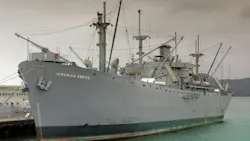
After humans conducted the first nuclear weapons test, the radioactive fallout contaminated steel. Experiments and instruments requiring low backgrounds relied on pre-nuclear steel as it lacked that contamination. Researchers would then obtain that material from older ships, including vessels from shipwrecks.
During rare-event searches (dark matter, neutrinoless double-beta decay, etc.), detectors can’t distinguish between radiation sourced from their surroundings and radiation generated by their target. That’s because background radiation, such as gammas, betas, and neutrons, deposit a similar energy range as the target signal. So, the system design needs to account for both to tell them apart.
Incoming cosmic rays from the sky constantly hit the detector. Radon gas and its short-lived decay products circulate through the air, settling onto surfaces. Traces of naturally radioactive uranium, thorium, and potassium-40 are present in the concrete, rocks, metals, and other materials used for labs and instruments. The detector’s shielding can also be a radiation source as it contains impurities, produces secondary particles when struck by neutrons or cosmic rays, and undergoes activation.
Those background signals are negligible during routine radiation measurements. However, in extremely low background experiments, they overwhelm the tiny signals engineers try to detect.
According to SNOLAB, some particle interactions its underground experiments try to target may rarely occur (once per tonne of detector material each year). That lab is located 2,070 meters underground to make those measurements. At this depth, the rock decreases the cosmic ray flux by approximately 50 million times. Experiments still need multi-layered shielding and thoroughly screened materials to mitigate the other backgrounds.
Pre-1945 Steel
This is where pre-1945 steel becomes useful. When atmospheric nuclear weapons testing started post-Trinity explosion, artificial radionuclides spread around the world and were embedded into newly made steel. Metal produced during smelting before that event wasn’t contaminated by the fallout. That makes pre-1945 steel practical for low-background applications.
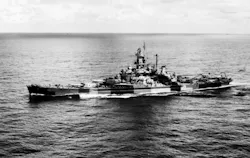
Pacific Northwest National Laboratory used shields made of pre-WW2 steel for extremely sensitive radiation measurements. For instance, it’s used steel from the scrapped battleship USS Indiana) (see figure) to build a shielded room. Roughly 30 cm of the hull plating reduced background from high-energy photons.
Using pre-nuclear steel led to a widespread misconception, suggesting that modern steel is too radioactive for highly sensitive experiments. This made others believe researchers recovered metal from salvageable ships. However, what actually happened is more complicated.
This steel is desirable as its radioactive history is simpler to understand. Teams analyze potential materials for radioactivity contamination. If they choose low-background steel, it often works best as the shielding or structural support instead of the active detector.
Today’s metals can be manufactured explicitly for ultra-low-background experiments. For PandaX-II, researchers had low-background stainless steel custom-produced for the experiment, which was used for the fabrication of the pressure vessel. It measured anthropogenic cobalt-60 at levels around 1 mBq/kg or lower. LUX-ZEPLIN had a similar technique, choosing a certain titanium alloy due to its cryostat with low uranium, thorium, potassium, and cobalt-60.
Low-background experiments depend on carefully selected materials, multi-layered passive shielding, underground sites, and active veto systems to identify and reject unwanted signals. As a result, researchers aren’t trying to find shipwrecks to retrieve pre-1945 hull plates. Although the steel is useful for cutting background radiation, it’s only one option to consider among several.
About the Author
 Cabe Atwell
Cabe Atwell
Technology Editor, Electronic Design
Cabe is a Technology Editor for Electronic Design.
Engineer, Machinist, Cartoonist, Maker, Writer. A graduate Electrical Engineer actively plying his expertise in the industry and at his company, Gunhead. When not designing/building, he creates a steady torrent of projects and content in the media world. Many of his projects and articles are online at element14 & SolidSmack, industry-focused work at EETimes & EDN, and offbeat articles at Make Magazine. Currently, you can find him hosting webinars and contributing to Electronic Design and Machine Design.
Cabe is an electrical engineer, design consultant and author with 25 years’ experience. His most recent book is “Essential 555 IC: Design, Configure, and Create Clever Circuits”
Cabe writes the Engineering Life & Engineering on Friday blog on Electronic Design.
See Cabe's cartoons & comic strips here.
Comment About the Article
To join the conversation, and become an exclusive member of Electronic Design, create an account today!
 Leaders Logo
Leaders relevant to this article: