Inside a Tornado with OTUS Project’s Tornado Research Drones
What you’ll learn:
- Insight into tornado data collection using custom UAVs.
- How the team managed to accomplish data collection around and within tornadoes.
- What the future holds for the OTUS Project.
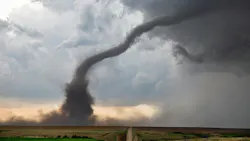
Imagine being an elite storm chaser trailing the edge of a supercell, spotting a tornado forming, then flying a drone directly into the heart of the funnel. That’s the idea behind The OTUS Project (Observations of Tornadoes by UAV Systems), an initiative that aims to produce customized UAVs designed to fly directly into tornados to garner atmospheric data.
According to the NOAA’s National Severe Storms Laboratory, much information about tornadoes is still unknown. Against widespread belief, they remain rare, are difficult to predict, and can cause billions of dollars in damage. The OTUS Project looks to help shed some light on the phenomena by combining storm science, innovative technology, and documentary film-making.
Established by Louis Tucker, Nelson Tucker, Tanner Beard, and Erik Fox, the Project provides advanced knowledge in drone racing and engineering, meteorology, storm chasing, aerospace systems, and severe weather research. According to The OTUS Project website, the mission of the team is to “protect lives and property by enhancing structural resilience, through wind & thermodynamic data collection that improves predictive models & hazard forecasting.”
Meet the Team
Nelson Tucker, a meteorology student at Millersville University and researcher with Tornado Talk, serves as the project’s founder and president and has had a long-standing interest in tornado science and severe weather. Louis Tucker serves as CEO and lead pilot. According to OTUS, he became the 2023 National Collegiate Drone Racing Champion and helped lead his school to a first-place finish in 2024. The project credits him with helping demonstrate that drone-based tornado research was possible when combined with the right engineering.
Tanner Beard, an aerospace engineer and spacecraft systems engineer, designed the project’s custom drone architecture, while Erik Fox, a retired Army veteran, meteorologist, storm chaser, and president of the National Storm Chaser Summit, serves as a safety lead and field operations expert.
Drone Hardware
Each drone used in the OTUS Project (Fig. 1) is custom-engineered to survive the harsh, dynamic environment inside tornadoes. The 3D-printed, hand-built UAVs are equipped with what the team calls thermodynamic sensors, flight telemetry systems, and custom weather instrumentation that measures temperature, humidity, pressure, and wind speeds from the areas surrounding the funnels before heading inside.
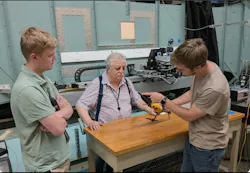
They’ve even partnered with National Institute of Standards and Technology (NIST) to develop a new vertical wind-speed sensor to measure thermodynamic conditions and 3D wind loads near the surface around tornadoes.
On the OTUS Project website, it states “Collecting measurements of temperature, pressure, humidity, and wind speed each have their own unique challenges and variables. A typical monitoring setup would be unable to collect useful information in the extraordinarily dynamic environment of a tornado, especially from a high-speed drone.
“The thermodynamic response times needed are so great that only specialized sensors are able to keep up. In addition, these sensors have to be simultaneously shielded from the degrading conditions while being sufficiently exposed and uncontaminated to measure them (Fig. 2). Most of our efforts have been in developing our own 3D wind sensor in collaboration with the National Institute of Standards and Technology (NIST) for tornado measurements on OTUS drones, as there is no lightweight sensor on the market which can measure such intense winds.”
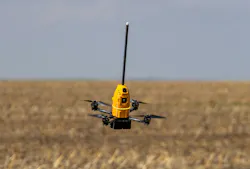
For the above picture, be sure to contact them if you find their drone on their Twitter(X) page.
First Tornado-Bound Drone
Less than three months after the OTUS Project was born, the first UAV was flown inside a tornado. The methodology begins with circles, flying orbital patterns orbital patterns around the tornado, and garnering data from the surrounding atmosphere at different altitudes. The drone then passes through the funnel itself. The collected data helps provide a comprehensive picture of what the air is doing both inside and outside of the tornado. No ground sensor system has ever been able to accomplish the same feat.
As with every engineering project, getting a drone to fly into a tornado isn’t as easy as it sounds. Drone operations require strict FAA regulations to fly both recreationally and commercially, which includes maintaining a visual line of sight and operation below 400 feet in uncontrolled space. Flying over people, night operations, and going beyond visual sight require agency waivers before operation, which can take a lengthy amount of time. Add to that the extreme weather, and the waivers can pile up.
It also takes a skilled pilot to fly a drone in rotation speeds that can reach over 300 mph, which Louis Tucker has managed to accomplish over a dozen times. In total, the team intercepted 10 tornadoes using 13 drone intercepts to garner valuable information that could provide thermodynamic and flight data to help increase forecasting and alert times, as well as an advanced stepping stone for next-generation wind sensors.
“We have collected incredible measurements that we are very eager to share with the wider world. It will likely be months before we can share this. Science, specifically for the benefit and safety of all people threatened by tornadoes, is what we exist for. We were founded with the goal of gathering measurements that will bring about real-world change, and that requires immense effort,” stated the team.
“We are still early on in our path to forwarding our understanding of tornado hazards, and we believe the future is bright. We want to push technological innovation to its limits and bring the entire weather world along with us for the journey. Once we have proven the scientific credibility and accuracy of our data, we will have many exciting things to share with you all.”
I first saw Project OTUS at the National Storm Chaser Summit a few years ago. The crowd of veteran storm chasers audibly gasped at what they accomplished. Jaws on the floor. They talked about their effort and showed some video inside a tornado that I can’t find on their social pages. I’m so impressed with their effort; I really hope I get a chance to interview them some day.
In the meantime, here’s another video I quite like. That red Oklahoma/Texas dirt always makes for a picturesque tornado. The way you can see the wind patterns across the landscape around the funnel is stunning.
About the Author
 Cabe Atwell
Technology Editor, Electronic Design
Cabe is a Technology Editor for Electronic Design.
Engineer, Machinist, Cartoonist, Maker, Writer. A graduate Electrical Engineer actively plying his expertise in the industry and at his company, Gunhead. When not designing/building, he creates a steady torrent of projects and content in the media world. Many of his projects and articles are online at element14 & SolidSmack, industry-focused work at EETimes & EDN, and offbeat articles at Make Magazine. Currently, you can find him hosting webinars and contributing to Electronic Design and Machine Design.
Cabe is an electrical engineer, design consultant and author with 25 years’ experience. His most recent book is “Essential 555 IC: Design, Configure, and Create Clever Circuits”
Cabe writes the Engineering Life & Engineering on Friday blog on Electronic Design.
See Cabe's cartoons & comic strips here.
Related
 tornado_dreamstime_l_20063996
 tornado_dreamstime_l_80456553
Comment About the Article
To join the conversation, and become an exclusive member of Electronic Design, create an account today!
 Leaders Logo
Leaders relevant to this article: