Stratasys 3D Printers Rig Rolls on U.S. Tour
What you’ll learn:
- Stratasys is conducting a multi-city USA tractor-trailer tour to show off its diverse 3D printer portfolio.
- A guy and a kid showing up, looking at, and playing with your sample 3D prints and printers like 10-year-olds may not be a good idea to kick off your demo trailer.
Last week, I had my 10-year-old minion under my roof, and I took on soccer mom duties in getting her to and from a morning soccer camp I signed her up for. With the laptop and phone, I can work from pretty much anywhere, so I'm either the lone nerd in the bleachers with a laptop or I retire to the air-conditioned comfort of my EV. There, I can plug into a little 12-V, 300-W inverter that easily lets me work my own body's limitation of hours without having to worry about a flat battery or burning gasoline/diesel.
Anyway, I was looking around for some interesting news links to post in the Thursday edition of my bi-weekly Automotive Electronics newsletter, as well as into our Electronic Design Weekly site wrap-up, and I encountered an announcement that Stratasys had a semi-truck loaded up for a roadshow. It was in Portland, about 20 miles' drive, from 10 am to 2 pm on August 13, 2025, the same day as we were at the soccer camp that morning. Might be interesting, so I looked into it further and registered to attend to see what their latest product touts were about.
A Bit of History
As a Maker, I go back to the early days of 3D printing when the choices of fused filament fabrication (FFF) machines were either a very crude A-framed gizmo that melted plastic filament into a non-heated bed, or one of the more expensive machines that only large companies could buy. I was a Kickstarter supporter for the Makibox, and an early investor in Techshop in Menlo Park, not far from Altera, where I worked at the time.
TechShop, a pioneer in what we now call a "Maker Space," managed to acquire a Stratasys Dimension FFF printer and had some interesting classes. They included SOLIDWORKS basics and advanced classes, as well as operating procedures for the Dimension — each about three hours if I remember it right.
TechShop's shop equipment was available for members to use, as long as they took a class on its operation and safety. I was pretty much checked out in everything: Bridgeport mills, lathes, welders, ShopBot, vacuum forming machine, 3D printers, laser cutters/engravers, Tormach CNC mill (I was a volunteer for TechShop at Maker Faires, giving demos of the Tormach CNC mill in operation), welders and, yes, even the massive waterjet we eventually got for the shop.
Operating on a Different Plane
After 9/11, air travel became a total pain with the TSA checkpoints. And with our decision to keep the quadruplets in Oregon to attend school and keep their friends, I was "commuting" to the Bay Area by commercial airline — Friday evenings up, and early Monday mornings back to the job at Altera.
This got old after a while, and I did the math where having my own aircraft worked out about the same in cost. But I could leave and return on my own schedule and I didn't have to check my bags to bring a bottle of Oregon Pinot Noir back to California. I bought a Mooney M20K 305 Rocket Conversion, an FAA-approved ("STC'd") hot-rod mod that stuffed a bigger, heavier, turbocharged engine up front. Doing so meant the tail had to push down harder during level flight and there was an order from the FAA to inspect the tails for metal fatigue (cracking) on prescribed intervals. There's the old Henny Youngman joke that goes something like:
Patient: "Doc, it hurts when I do this."
Doctor: "Then don't do that."
So, I made a steel mold at Techshop and had a very dense alloy poured into that mold by a boat ballast foundry in East Bay (it was surreal watching them reach into a large box of a mineral and throw it into the melt to create the heavy alloy) to weigh the tail down by a precisely engineered amount. Without the parasitic drag due to a return to stock downforce loads, the plane picked up speed (a fair bit of it) and, most importantly, I completely got rid of the loading that made the tailplanes crack. But there was still room for improvement.
Looking at the Mooney fuselage, it had some drainage tubes protruding from the belly. A round tube has a lot of drag; whether a half inch in diameter of two inches, it's about the same drag. So, it only made sense to fair those tubes by slipping a wing-section fairing over each one.
This is where the Stratasys 3D printer came in. It would be my first experience going from newly-learned SOLIDWORKS (I did Autocad back when it was on 5-¼ floppy disk) to something practical and massively functional. I printed and installed them to see the result.
On my subsequent commutes, I'd get radio calls from Center, asking if I really was a Mooney based on my ground speed of 215 kt at 10,500 ft. On one trip, I clocked 255 mph at 21,000 ft. on a trip back from the Middle East (Central Illinois) to Oregon.
My bird got me to work in San Jose, door to door, about as fast as commercial airlines for about the same money. I could fly on my own schedule and not worry about flight cancellations. I could have whatever cargo I wanted to carry, and flying my plane was one of my joys. Was.
Patient: "Doc, it no longer hurts before I do this."
FAA Chief Flight Surgeon: "Then no longer do that. Ever."
Hitting the Road
So, after the soccer camp, we hit the road at noon, at a time when it seemed every Portlander with no clue of how to make a sandwich for lunch was on the road. Cruising the parking lot at the Oregon Museum of Science and Industry (OMSI), we found the Stratasys semi parked in a gravel overflow lot. We were somewhat relieved to have only a few other people attending where we just walked in. It was strange to arrive and see a semi and a flatbed trailer parked beside an ~16-foot-wide by 44-foot-long small building (it turns out that the sides of the "building" push in, like an RV, and hydraulic stilts lift the building up so that the flatbed can drive under it), as shown in Figure 1.
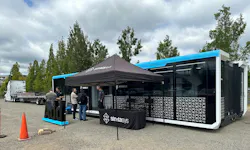
I was a bit disappointed that there weren't live 3D-printing demos going—machines in action. But after noodling on it a few hours, it made sense that prints taking several hours to finish and needing post processing during the 10:00 am to 2:00 pm exhibit window weren't in play. A few machines were on static display, as well as a bunch of prints made by them that were out for display. The trailer was well-staffed and they were informative, knew their stuff, and weren't pushy.
Here's a share of what we saw (we were having a good time with it, but trust me, it was serious and technical when it came to my questions).
Stratasys J55
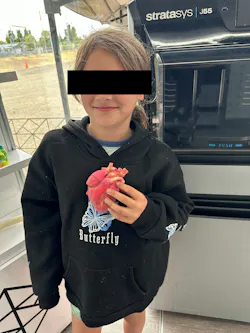
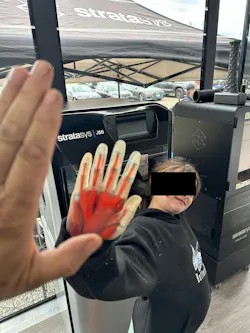
This is progeny from one of the older mergers, where Objet Geometries joined up with Stratasys back in 2012. The Polyjet can be thought of as an inkjet that can "print" resin layers to form multi-material or multi-property 3D prints. Several 3D prints were on display, so we picked a few to mess around with. Figures 2 and 3 were fun and, fortunately, we weren't kicked out of the trailer with our antics. This this was prior to me formally introducing myself, while The Minion was in her post-soccer-camp outfit and I was in my soccer-mom attire.
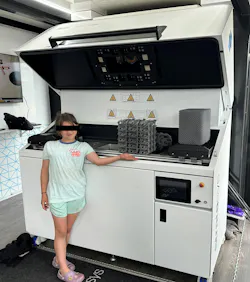
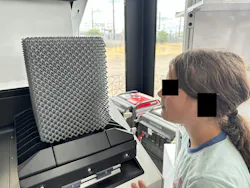
One of the modules contains powdered material that’s delivered and leveled in the tub area (just off Minion's left shoulder) to form a powder layer. It subsequently returns to its "home" location. Then the module on the other side sprays a binder material to selected locations on the layer where the material is to be solidified. Like a tanning bed on steroids, a powerful UV lamp in the lid cures the binder and the whole process repeats until the full model is built up. Two of the models made by the machine are sitting on the printer. Figure 5 shows a closeup of one of the models and of the material transfer modules it's resting on.
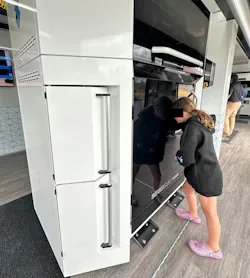
Though we're limited in what we can cover here, a few more machines were on display in the trailer, including Stratasys' F370CR, Origin, Neo, and the new, monstrous, F3300 high-temperature, 4-printhead FDM printer shown in Figure 6.
Since we were at OMSI, Minion and I then stopped in for a look at another tour — genuine artifacts salvaged from the wreck of the Titanic. One of the salvaged items was a chandelier (Fig. 7).
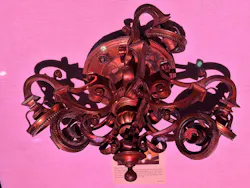
Unfortunately, I was a dope who failed to bring to the fore of thought that the iPhone 14, which I recently bought to be able to function in the "you have to upgrade your perfectly functional app" world, was selected by me BECAUSE it has a LiDAR scanner. I could have 3D-scanned that one with the phone and then made a fairly faithful, 1:1 scale, 3D reproduction, complete with LED lighting. Gah!
Photo Finish
Speaking of pics, on our way out of OMSI with the car at around 4 pm, Minion and I spotted the Stratasys "building," retracted and on the semi's flatbed, ready to hit the road with the diesel idling. I stepped up to the driver's window and advised him about how to stay off Portland's main highways — they rival the 405 in Los Angeles as far as being a commuters' parking lot —to bypass most of the traffic on his way to the next venue in Hood River, Oregon.
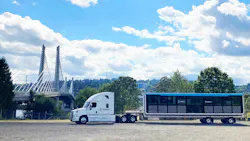
I then asked him if he'd mind positioning his rig for me in the empty overflow lot for a picture and he happily agreed, telling me to guide him into the position I wanted. So, we did that, and it's how my photo of the rig, with the Willamette River, Tillicum Crossing (the newest bridge in Portland), and the "West Hills" of Portland, was created for the lead image of this article.
I thought everyone had left, but the Stratasys guys appeared, somehow, and availed themselves of their own pics with the rig in position, so you may see a similar pic in their marketing or sales stuff at some point.
Coming to a City Near You
The Experience Stratasys Tour 2026 runs through mid-November, including stops in Harrisburg, Pa.; Boston, Mass.; Somerset, N.J.; Wichita, Kans.; San Diego, Calif.; and Anaheim, Calif. To register to attend, click here.
About the Author
 Andy Turudic
Andy Turudic
Technology Editor, Electronic Design
Andy Turudic is a Technology Editor for Electronic Design Magazine, primarily covering Analog and Mixed-Signal circuits and devices and also is Editor of ED's bi-weekly Automotive Electronics newsletter.
He holds a Bachelor's in EE from the University of Windsor (Ontario Canada) and has been involved in electronics, semiconductors, and gearhead stuff, for a bit over a half century. Andy also enjoys teaching his engineerlings at Portland Community College as a part-time professor in their EET program.
"AndyT" brings his multidisciplinary engineering experience from companies that include National Semiconductor (now Texas Instruments), Altera (Intel), Agere, Zarlink, TriQuint,(now Qorvo), SW Bell (managing a research team at Bellcore, Bell Labs and Rockwell Science Center), Bell-Northern Research, and Northern Telecom.
After hours, when he's not working on the latest invention to add to his portfolio of 16 issued US patents, or on his DARPA Challenge drone entry, he's lending advice and experience to the electric vehicle conversion community from his mountain lair in the Pacific Northwet[sic].
AndyT's engineering blog, "Nonlinearities," publishes the 1st and 3rd Tuesday of each month. Andy's OpEd may appear at other times, with fair warning given by the Vu meter pic. His cartoon series, "Inventors", appears each week in Electronic Design Weekly.
Comment About the Article
To join the conversation, and become an exclusive member of Electronic Design, create an account today!
 Leaders Logo
Leaders relevant to this article: