High-Speed ADC Tracks Power Ups and Downs of AI
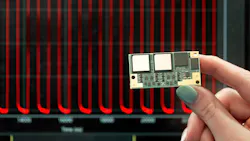
Today's AI accelerators consume so much power so fast that it can overwhelm the power delivery network (PDN) on the board, the server power supply, and the broader grid. As AI workloads ramp up or down, processors such as NVIDIA's Blackwell and AMD’s Instinct GPUs can leap from near idle to full power almost instantly, with peak power levels reaching 50% to 60% above the rated thermal design power (TDP).
These rapid load transients can cause voltage droops, overshoots, and other faults at the processor’s power rails, sometimes occurring in nanoseconds. Catching these faults is critical. Left undetected, they can cause servers and cooling systems to run on weak, fluctuating power, increasing the risk of hardware damage, overheating, unexpected reboots, all of which can cause costly downtime and even extend training runs for new large language models (LLMs).
"When there's a blackout, that's a very dramatic event that can bring the entire AI data center down," said Karthik Vasanth, VP and GM of data converters at Texas Instruments. "But there is a more subtle problem, which is a brownout, where you have a small voltage glitch on one of these racks, and that puts the model or a portion of the model out of commission or cause the rack to not function properly. And these AI models are not just residing in one of these racks; they're probably residing in the entire data center. So it's no longer acceptable [to be] down even for a small amount of time because of the repercussions."
However, board-level power glitches can happen so fast that traditional power-monitoring approaches miss them. “You’re looking for a little needle buried somewhere in a massive haystack, which is the data center,” Vasanth said.
TI is trying to tackle the problem with its latest analog-to-digital converter (ADC), the ADC34DSO75. Sampling at up to 3 gigasamples per second (GSPS), the device can capture power glitches at nanosecond-scale resolution, which is fast enough to enable event-based remote monitoring of processor power rails. TI said the four-channel, 14-bit ADC is thousands of times faster than current solutions, efficient enough to monitor power rails continuously, and small enough to fit inside the server.
The result is a solution that extends real-time remote power monitoring throughout the data center, said Matthew Hann, product line manager for high-speed data converters at TI. Introduced at the OCP Global Summit this week, it gives hyperscalers the ability to detect hidden electrical risks before they escalate into system failures, he said.
“In a sense, it brings more intelligence to the edge, and the edge is the GPU power rails and CPU power rails."
What Happens When Power Falls Behind AI Processors?
The ADC34DSO75 comes amid rising power demands from AI data centers, Vasanth said. At the chip level, AI accelerators such as NVIDIA's Blackwell GPUs are burning through more than 1 kW of power each, with TDP ratings as high as 1,400 W. At the rack level, power specifications are also rising, with NVIDIA's Blackwell-based racks reaching up to 120 kilowatts (kW) and its next-generation Rubin-based racks scaling to 600 kW. At the level of a full data center, thousands of these racks can guzzle gigawatts of power.
Data centers rely on telemetry to provide engineers with real-time information about voltage, current, power, temperature, and other conditions inside these systems, which can then be used to support protection, system monitoring, and performance optimization.
But the dynamic power demands of AI workloads pose a new challenge, Vasanth said. Most AI workloads are not uniform. They tend to consumer power in very short, sudden bursts, usually when the processor starts running a computationally intense portion of the training run or inference model. As a result, AI processors can experience load transients (di/dt) with slew rates of more than 2000A/µs at the processor and more than 2.5A/µs at the power supply unit (PSU) as they shift from idle to full power.
These rapid changes can outpace the response of the power electronics in front of them, including the rack-level power supply and the board-level voltage regulators. The result is voltage undershoots, overshoots, or other transient events at the processor power rails, many of which can unfold in nanoseconds (Fig. 1). That can sometimes cause these power rails to glitch, Vasanth said, even when large numbers of decoupling capacitors are placed close to the processor.
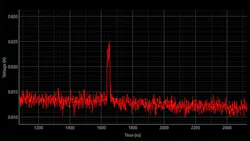
These events occur so fast that they are more like fault conditions than typical load transients. In a millisecond, a server can experience several nanosecond-scale events. Undetected, they can trigger resets, throttling, and interrupted workloads, reducing AI compute performance. Scale that up to the largest AI deployments, where tens of thousands of GPUs power up and down at the same time to execute the same workload, and these board-level glitches can even cause outages.
However, most telemetry systems are not capable of capturing these events, Hann said. Sampling at millisecond intervals, they can identify voltage droop and other power anomalies at the server level but miss the transient events now occurring more often at the processor power rails. The result is a blind spot where everything seems to be operating normally, with no obvious issues in power, thermal performance, or utilization, even as elusive faults continue to occur.
While nanosecond-scale power monitoring is possible, it usually depends on FPGAs, which can add cost, power consumption, and hardware complexity.
These constraints have made it difficult to deploy this level of monitoring both inside individual servers and across thousands of racks, Hann pointed out.
Real-Time Power Monitoring on Low-Voltage, High-Current Rails
By combining high-speed sampling with advanced on-chip digital signal processing in a small form factor, TI said the ADC34DSO75 can detect nanosecond-scale faults in real time. The device delivers sampling speeds of up to 3 GSPS and full power input bandwidth of 3GHz due to its buffered analog inputs, enabling it to track the fast-changing conditions on processor power rails, Hann said.
The most advanced AI chips also operate at low core voltages (VCORE), usually around 0.8 V to 1.2 V, so even a slight fluctuation of tens of millivolts can cause instability. Featuring a signal-to-noise ratio (SNR) of 68-dB and low phase and amplitude noise, TI said the ADC can continuously monitor low-voltage, high-current power rails with enough resolution to resolve these sudden, small variations. In these situations, noise and dynamic range are as important as sampling speed and bandwidth, TI said.
Hann said the new ADC also works without overly burdening the server's power budget, consuming 1.6W per channel at its full sampling speed.
While pinning down a nanosecond-scale power glitch is challenging, so is capturing it without drowning the system in data. To reduce the power and performance penalties that come with constant monitoring, the ADC uses “event-based” telemetry. Rather than logging everything happening on a power rail, it only records voltage overshoots and undershoots it has been programmed to detect. By capturing events and not every sample, data can be offloaded to a small MCU, eliminating the need for a costly, power-hungry FPGA.
Each ADC channel comes with an independent event-detection engine that monitors for these conditions and triggers data capture when they occur. Engineers can program the parameters of the device to detect voltage levels above or below specified limits, while additional settings can monitor the rate of change within a given time window, which both help hyperscalers tailor power monitoring to their system’s specific requirements.
Once a fault or other transient event is detected, the ADC saves the relevant samples in on-chip memory. The device integrates 256 kB of memory that can be divided among its four channels, enabling engineers to store samples captured before, during, and after a fault. The ability to save pre-trigger and post-trigger data gives engineers valuable context on the electrical conditions leading up to an event, turning what might otherwise look like a random system failure into a traceable sequence of cause and effect.
According to TI, the ADC’s combination of accuracy, speed, efficiency, and small form factor enables fully remote power telemetry throughout the data center. Today, engineers can sometimes spend hours or even days on troubleshooting, scanning hardware, firmware, and system logs to isolate intermittent faults. Alternatively, they need to intervene directly, cracking open the server and connecting a high-speed oscilloscopes to the power rail and wait for a rare transient event to reoccur, increasing downtime.
“You can program what you're looking for, and when that event actually happens, you store the information in memory,” Hann said. “You can download it and process it when you want to or as fast as you want to. It's like having an oscilloscope for each node without the bulkiness of an oscilloscope.”
How Faster Power Monitoring Improves Data Center Reliability
The ADC34DSO75 is designed to scale depending on the number of power rails that need to be monitored and the amount of visibility that companies want into the conditions before, during, and after the event. Several devices can be daisy-chained together to increase the number of channels while using the same octal SPI interface to the MCU. The device has “the flexibility to be able to capture events wherever a hyperscaler feels is a contentious rail that needs monitoring and analysis over time,” Hann said.
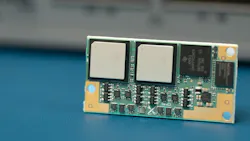
To give customers a blueprint for building one of these power-monitoring nodes, TI also introduced a system-on-module (SOM) based on the ADC. The module integrates a pair of ADCs to monitor up to eight voltage rails with nanosecond resolution (Fig. 3). It also comes equipped with external flash memory, so if power goes out during a blackout or other catastrophic event, engineers can salvage the stored data and reconstruct the electrical conditions preceding the incident. "Think of this as a black-box recorder," Vasanth explained.
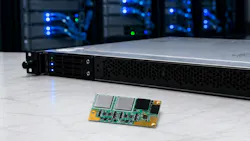
TI said the ADC can be deployed throughout the rack for localized monitoring. Different locations place different demands on power telemetry: monitoring at the PSU often focuses on millisecond-scale events, while monitoring tightly regulated power rails on the PCB requires nanosecond-level visibility. The ADC34DSO75 can manage both, Hann said. “What we've designed is a high-speed, fully remote, and highly efficient watchdog for the most critical power infrastructure."
Looking ahead, nanosecond-level power monitoring opens the door to predictive fault detection and automatic system management, TI said. By recording transient events and analyzing the data over time, engineers can spot patterns that precede brownouts, performance degradation, or other reliability issues. These insights could help hyperscalers build models that predict brownouts and other failures before they occur and improve overall data center reliability, Vasanth said.
The need for this level of insight is only rising. As data centers become larger, denser, and more power-hungry to handle AI, the cost of a single outage can reach hundreds of thousands of dollars per hour. As a result, hyperscalers are targeting automotive-grade reliability or above. Meeting these standards requires more visibility into what’s happening in hardware, down to nanosecond-scale transients that can foreshadow larger failures.
About the Author
 James Morra
James Morra
Senior Editor
James Morra is the senior editor for Electronic Design, covering the semiconductor industry and new technology trends, with a focus on power electronics and power management. He also reports on the business behind electrical engineering, including the electronics supply chain. He joined Electronic Design in 2015 and is based in Chicago, Illinois.