What are Strain-Tunable Thermal-Conductivity Applications?
What you'll learn:
- How the thermal conductivity of a unique material is affected by the draw-induced strain.
- The underlying materials-science physics and test data numbers associated with this development.
- Possible uses for this reversible phenomena.
I often read about fundamental developments in materials or devices that seem to be what’s derisively described as “a solution looking for a problem to solve.” After all, that’s what many journalists said about the optical laser when it was demonstrated at a press conference by physicist Theodore Maiman in 1960 — and we know how that turned out.
It’s easy to be dismissive of these research developments, because they fall into the “huh?” category. At the same time, you never know which ones will give someone in an unrelated area just what they needed for their project, or even become the foundation of an entire industry. Think of heat-shrink tubing, Teflon, Gore-Tex, or nitinol as examples of materials that were developed without a specific application, until they found a role and became widely used.
Improved Thermal Conductivity is a Stretch
Now I see another research development that leaves me similarly wondering. A research team at the Massachusetts Institute of Technology (MIT) has developed a ductile material with thermal conductivity that consistently and repeatedly increases by a factor of two as the material is stretched (technically, “strained”).
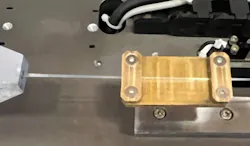
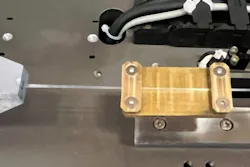
The thermally reversible material is an olefin block copolymer (OBC) — a soft and flexible polymer that’s used in a wide range of commercial products. The team found that when the material is quickly stretched, its thermal conductivity transition occurs within just 0.22 seconds, which is the fastest thermal switching that’s been observed in any material (Fig. 1).
The team’s project actually began with investigation of more sustainable alternatives to spandex, a synthetic fabric made from petroleum-based plastics that’s traditionally difficult to recycle. They looked at fibers made from a well-known polymer of polyethylene and closely related materials, including OBC.
OBC is predominantly an amorphous material, made from highly tangled chains of carbon and hydrogen atoms. Scientists had therefore assumed that OBC would exhibit low thermal conductivity. If its conductance could be increased, it would likely be permanent, similar to polyethylene.
Polyethylene has a backbone of carbon atoms arranged along a simple chain; carbon is a very good conductor of heat in all of its allotropes. Despite carbon’s high heat conductance, the disordered arrangement of chains typically impedes heat flow. Polyethylene and most other polymers, therefore, generally have low thermal conductivity.
Elasticity Experiments
However, experiments to test the elasticity of OBC revealed something quite different. As they stretched and released the material, they found that its thermal conductivity was quite high when it was stretched and lower when it was relaxed. Unexpectedly, this effect lasted over thousands of cycles and the switch was reversible, while the material stayed mostly amorphous.
Why was this happening? This being MIT and a research project, the team used a combination of X-ray and Raman spectroscopy to observe the material’s microscopic structure as they stretched and relaxed it repeatedly.
They observed that in the unstretched state, the material consists mainly of amorphous tangles of carbon chains, with just a few scattered islands of ordered, crystalline domains. When stretched, the crystalline domains seemed to align and the amorphous tangles straightened out, similar to what was observed in polyethylene (Fig. 2).
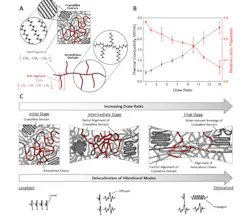
However, rather than transitioning entirely into a crystalline phase, the straightened tangles stayed in their amorphous state. In this way, the team found that the tangles were able to switch back and forth, from straightened to bunched and back again, as the material was stretched and relaxed repeatedly.
Where Does this Discovery Lead?
All of this is fascinating, but my question remains: Where does it lead, if anywhere? The team speculates it could be used for fibers that can quickly react to dissipate heat for electronics, fabrics, and building infrastructure. I’m not quite seeing that, as real work (in the physics sense) must be done to stretch the fiber, and work takes energy/power.
On the other hand, there’s a similar scenario with substances such as the previously cited nitinol, another innovative material that started out with no clear applications. This biocompatible, high-performance alloy of nickel and titanium (NiTi) has a unique shape memory effect (returning to a preset shape when heated) and superelasticity, as it’s flexible with reversible deformation up to 30 times more than ordinary metals.
Nitinol is now widely used in medicine for self-expanding stents, guidewires, orthopedics, and surgical tools due to its ability to conform to body structures, as well as for trimming the attack angle of some airfoils and other “strange” nonintuitive applications.
Do you have any ideas how olefin block copolymers could be used for thermal management in electronics or in any other application? Is the 2:1 conductivity range adequate, or does it need to be higher for the material to be truly useful? Or perhaps thermal management isn’t its best application, but its thermal characteristics will enable other, as yet unforeseen, applications? Can you think of any other innovations whose benefit was not realized until later, or in an unanticipated direction?
The full details on this project are available in their paper “Strain-Tunable Thermal Conductivity in Largely Amorphous Polyolefin Fibers via Alignment-Induced Vibrational Delocalization” published in Advanced Materials, but it’s behind a paywall. Fortunately, MIT has also posted a version at their “Open Access” site.
About the Author
 Bill Schweber
Bill Schweber
Contributing Editor
Bill Schweber is an electronics engineer who has written three textbooks on electronic communications systems, as well as hundreds of technical articles, opinion columns, and product features. In past roles, he worked as a technical website manager for multiple topic-specific sites for EE Times, as well as both the Executive Editor and Analog Editor at EDN.
At Analog Devices Inc., Bill was in marketing communications (public relations). As a result, he has been on both sides of the technical PR function, presenting company products, stories, and messages to the media and also as the recipient of these.
Prior to the MarCom role at Analog, Bill was associate editor of their respected technical journal and worked in their product marketing and applications engineering groups. Before those roles, he was at Instron Corp., doing hands-on analog- and power-circuit design and systems integration for materials-testing machine controls.
Bill has an MSEE (Univ. of Mass) and BSEE (Columbia Univ.), is a Registered Professional Engineer, and holds an Advanced Class amateur radio license. He has also planned, written, and presented online courses on a variety of engineering topics, including MOSFET basics, ADC selection, and driving LEDs.
Comment About the Article
To join the conversation, and become an exclusive member of Electronic Design, create an account today!
 Leaders Logo
Leaders relevant to this article: