A Movable Fab: Precise Motion Control for Chip Manufacturing
What you’ll learn:
- How advanced motion algorithms improve semiconductor-stage throughput and repeatability.
- Why embedded control and monitoring can improve reliability and compactness.
- How high-resolution encoders expand precision-positioning design options.
This article was written in collaboration with Dover Motion.
Precision motion control is fundamental to modern semiconductor manufacturing, enabling critical applications like wafer transport, inspection, lithography, and advanced packaging.
In each case, positioning accuracy directly affects yield, throughput, and device performance. Wafer-handling systems need to move fragile substrates quickly and reliably between tools, while inspection and metrology equipment require nanometer-scale positioning to detect increasingly small defects and process variations.
Lithography, too, depends on ultra-precise motion to accurately transfer microscopic circuit designs onto silicon wafers. Similarly, hybrid bonding and other types of advanced packaging require exact alignment between dies to create high-density interconnects.
As semiconductor process nodes shrink and packaging technologies become more complex, precision motion control is being pushed to new limits. Keeping up with these demands requires advances across the board, including motion-control algorithms, embedded control architectures, and sensor technologies used in OEM semiconductor equipment.
The Unique Motion-Control Needs of Semiconductor Equipment
Precision motion control in semiconductor applications requires addressing several critical factors.
First, these systems need to consistently achieve rapid yet precise positioning for tasks such as wafer transport, inspection, defect analysis, metrology, dicing, die bonding, and packaging, all to maximize the output of the fab. Minimizing mechanical vibrations is also crucial to prevent damage to delicate components — inside the machinery itself and the chips moving through it — and to maintain measurement accuracy. Optimizing motion profiles to reduce jerky movements is essential.
On top of these factors are robustness and reliability: Semiconductor equipment depreciates fast, making any downtime unacceptable. As a result, motion systems need to be industrial grade to enable continuous, reliable operation. Given the high cost of semiconductor equipment and finite space within the fab, miniaturization of the motion-control system is increasingly important as well. This also brings big benefits in performance by shortening sensor connections, thus reducing signal noise.
But above all is precision. Many semiconductor manufacturing processes require positioning resolution within nanometers or even picometers. A new class of ultra-high-resolution encoders, along with high-speed serial interfaces and advanced signal-processing algorithms, are driving major improvements in the resolution, size, and cost of the XYZ tables that can handle these demands.
Advanced Motion-Control Algorithms in the Drive for Consistency
To ensure optimal performance and precision in the demanding world of semiconductor manufacturing, the underlying motion-control systems must leverage the most advanced technological capabilities. From state-of-the-art current control to sophisticated filtering and feedback mechanisms, these innovations are essential for driving efficiency and reliability in the fab. Here’s a rundown of the key motion technologies that address this need:
Decoupled Control Loops
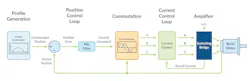
Separating the current and position loops allows for tailored loop tuning. The current loop manages instantaneous motor torque, while the position loop handles disturbances, which is key for maintaining process stability across varying loads and conditions, regardless of the motor. Figure 1 shows what has become the go-to approach for high-performance motion control of each motor in the system.
Field-Oriented Control (FOC)
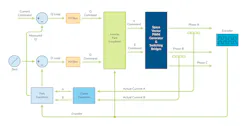
FOC enables precise torque management by controlling the vectorized motor current (Fig. 2). FOC algorithms are more computationally demanding than some other approaches, requiring transformation of the motor phase current to a stationary DQ calculation space. But the benefits greatly outweigh the cost and have a direct impact on increases in throughput and repeatability.
Algorithmic and Table-Based Feedforward Compensation
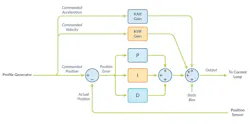
Acceleration and velocity feedforward values address predictable system dynamics, reducing the workload of PID loops (Fig. 3). Optimized feedforward gains contribute to significantly improved move and settle performance, directly impacting throughput in high-speed semiconductor processes.
Going further, table-based compensation schemes can provide additional capabilities, including position-specific feedforward terms (also known as gain scheduling), compliance compensation, and encoder accuracy enhancement. It may be possible for production units of the same design to share a common compensation table, or it may be necessary to create a table tailored for each unit.
Predictive Feedforward Tuning
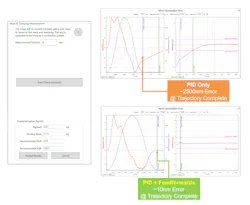
Today’s tuning tools are designed to accurately estimate system inertia and drag. This capability enables auto-optimization of feedforward gains, which in turn leads to significantly reduced position error at the end of the commanded move trajectory (typically less than 10 nm) as well as very precise position tracking.
Predictive tuning also enables faster and smoother movement within the motion stage, directly impacting the precision and speed of critical semiconductor processes (Fig. 4).
Frequency Domain Analysis with Bode Plots and Active Filtering
Sinusoidal excitation test signals allow the control system to perform rapid, accurate frequency-response measurements of the controlled mechanism. The ability to create Bode plots in-situ offers invaluable insights, including:
- Precise characterization of payload-affected dynamics.
- Accurate identification of system-level mechanical resonances that impact a positioning stage, which can then be compensated for by using programmable filters in the control system.
- Thorough verification of control bandwidth and robustness, which is crucial for ensuring the long-term stability and consistent performance of motion systems in demanding semiconductor equipment.
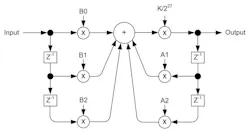
Dual biquad filters embedded within the controller suppress mechanical resonances and ambient disturbances, enabling coherent motion with minimal vibration. This is critical for maintaining process integrity during sensitive steps in the manufacturing process, including deposition, which builds up the transistor and wiring layers of a chip, and metrology, which inspects these features to make sure that they meet specifications. Figure 5 shows the calculation flow for one of these filters.
Profile Optimization is a Vital Tool for Vibration Reduction
The choice of motion profile significantly impacts the efficiency and precision of semiconductor manufacturing processes. Trapezoidal profiles, while offering fast acceleration, tend to excite higher harmonics within the system. This often leads to prolonged settling times, which can ultimately impede overall throughput in high-speed applications.
In contrast, S-curve profiles provide a smoother transition during acceleration and deceleration. This inherent smoothness effectively reduces mechanical resonance and shortens the total move-settle cycles. The result is a direct improvement in throughput, which is a critical performance indicator in semiconductor production.
By adding additional profile phases in point-to-point transfer moves, far less resonant energy is injected into the mechanism. In the S-curve profile in Figure 6, the percent of time spent in phases that transition from one acceleration value to another are tuned to maximize vibration reduction and minimize increase in profile time. Often just spending 1% or 2% of the total profile time in the acceleration transition phase results in dramatic vibration reductions.
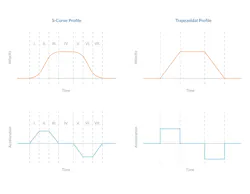
By comparison, trapezoidal profiles spend no time transitioning, instantly changing from one commanded acceleration to another (Fig. 6, again).
To accommodate the complex and precise movements required in semiconductor manufacturing, custom motion profiles are another tool in the toolbox. But executing these profiles requires advanced motion-control capabilities such as:
- Synchronized multi-axis scanning, vital for applications such as coordinated XY wafer scanning combined with dynamic Z autofocus.
- Precise frequency sweeps and chirps for in-depth system characterization and calibration.
- The execution of preprogrammed, choreographed motion for complex, multi-step process operations.
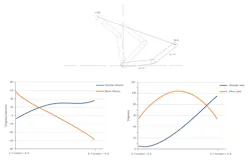
- Optimized move trajectories for non-orthogonal mechanisms such as SCARA arms, Delta Robots, and other specialized wafer and cassette transport mechanisms used in SMIF pod or other cassette conveyer systems.
As outlined in Figure 7, a straight-line move in XY space executed on a SCARA arm linkage requires motor-joint profiles that are anything but linear. It’s essential that controllers can handle these coordinate transforms in real-time or store them in advance in the form of a library of pre-determined moves.
Smart Motion Monitoring Improves Reliability and Reduces Downtime
Ensuring the longevity and reliable operation of high-precision motion systems in semiconductor manufacturing environments necessitates robust safety and protection mechanisms.
One of the more important features is I²t monitoring, which protects motors from thermal overload by continuously monitoring and integrating current over time. It helps increase longevity and prevents costly stage downtime in demanding semiconductor environments.
Figure 8 illustrates how a motor-control system can use I²t monitoring to its advantage. The graph shows a point in time where the motor current exceeds the continuous current limit. The integrated energy increases until the energy limit is exceeded, at which point the motor current isn’t allowed to exceed the continuous current limit. A full recovery requires the motor current to stay below the continuous current until the integrated energy has completely drained.
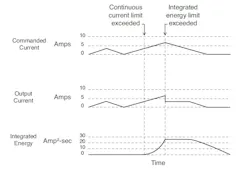
By drawing a correlation between integrated energy and motor temperature, this mechanism prevents failures related to high temperature but still allows for short term power boosts.
Temperature, voltage, and current monitoring are part of the broader protection strategy. Strategically placed thermistor inputs enable targeted thermal feedback for internal stage components. This active monitoring helps prevent overheating and ensures consistent, reliable performance even under continuous operation.
Similarly, high-speed voltage and current sensing electronics, including DC bus shunt resistors, provide comprehensive undervoltage and overvoltage as well as overcurrent protection. They safeguard sensitive electronics and ensure operational stability in dynamic and potentially harsh electrical environments.
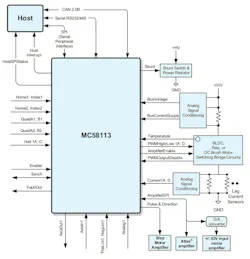
Figure 9 shows a typical arrangement of analog A/D inputs coupled with sensing electronic elements such as thermistors and current-sense resistors. Modern controllers monitor these signals as frequently as 20,000 times per second, minimizing the chance that a fault will not be responded to in time.
Embedded Integration: Architectural Shift in Motion-Stage Design
Embedded control, in which the motion controller and feedback systems are housed directly inside the stage, is one of the most significant advances in precision positioning for chip manufacturing.
This level of integration is important in the XYZ stages such as Dover Motion’s SmartStage positioning products. These motion stages are used throughout semiconductor fabs, whether to move polished silicon wafers between process tools or to position them with nanometer-level precision during manufacturing and inspection operations. They move wafers, tools, or other objects along three orthogonal linear axes, enabling precise three-dimensional alignment and motion control.
Moving the control electronics into the stage or actuator itself comes with several advantages:
- Proximity to sensors and actuators, reducing analog and encoder run lengths to improve signal integrity, which is critical for nanometer-scale precision in semiconductor applications.
- Minimized cabling, noise, and system complexity, simplifying integration into space-constrained and complex semiconductor manufacturing equipment.
- Compact system architecture, ideal for integration into equipment where space is often at a premium.
- Ultra-precise current control, which is the key to fast response times and precise position control. Localizing and minimizing the distance delicate current signals travel has a direct impact on the smoothness and accuracy of the actuator motion.
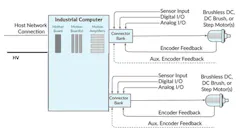
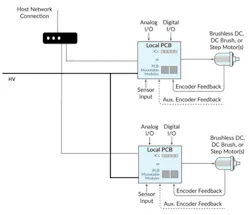
Figures 10 and 11 illustrate the difference in architecture between embedded, or local, control and remote control.
Whether implemented as ICs or complete modules, motion controllers continue to shrink even as their performance climbs. These compact devices are making it practical to move control electronics closer to the stage, unlocking many of the advantages of embedded motion control.
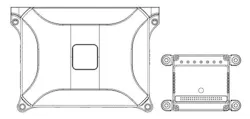
This trend is illustrated by Figure 12, which shows the progression of a typical cable-connected control module to today’s PCB-mounted drives. Despite the size decrease, a smaller-form-factor system such as ION/CME N-Series from Performance Motion Devices (PMD) can deliver more than 1 kW of power, compared to 500 W for the larger unit. It also offers performance gains, including 10X higher processing power and support for a wide range of sin/cos and serial encoder interfaces.
A New Class of Encoders Enables a Revolution in Positioning Accuracy
The future of precision motion control in the semiconductor industry is being shaped by several key trends aimed at pushing the boundaries of performance and efficiency. A key factor is the development of miniaturized, high-resolution encoders, which will be integrated directly into every axis to enable even finer control and positioning accuracy.
Frequently, these encoders dispense with traditional quadrature A, B signaling. Instead, they use high-speed serial links to connect the encoder to the controller. By switching to a serial interface, the highest performing encoders — those providing absolute and ultra-high resolution — have suddenly dramatically shrunk in size and cost, opening the door to entirely new machine design choices.
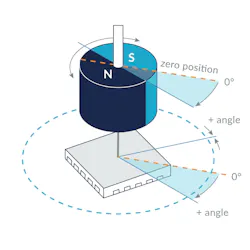
The use of advanced signal-processing electronics mounted in the encoder, or nearby in the embedded motion-control system, has also helped reduce cost and expand design options. Figure 13 features a magnetic encoder, which is representative of encoders that rely extensively on electronic interpolation to deliver high resolution at a low cost.
Sin/cos encoders, often used with linear BLDC motors, similarly work best when integrated with a nearby controller to improve signal fidelity, enabling resolutions down to around 300 picometers, speeds up to 1 m/s, and position stability within 1 to 2 encoder counts. This capability is critical for precision semiconductor manufacturing systems requiring both speed and nanometer-level accuracy in applications such as wafer alignment, metrology, and die bonding.
By combining low-cost, high-resolution encoders with special control algorithms, engineers are giving a second look at more traditional types of motors. Closed-loop stepper motors, for instance, can deliver close to the same precision and responsiveness of servo systems in a more cost-effective design. In that way, they bridge the gap between traditional steppers and more complex servos for two-phase step-motor control.
Finally, there's a growing emphasis on co-designed actuators, where the mechanical structure, dynamic behavior, and controller are designed in tandem with the choice of encoder and signal-processing technique to achieve optimal overall performance in future semiconductor equipment.
Conclusion
Leading-edge motion-control solutions powered by embedded controllers, sophisticated algorithms, and integrated safety mechanisms are ushering in the next generation of semiconductor equipment.
With the prevalence of high-performance motion-control ICs and drive modules from the likes of PMD and off-the-shelf motion stages such as those from Dover Motion, OEMs are gaining the ability to design faster, more precise, more reliable, and more compact control solutions specifically tailored for the rigors of semiconductor manufacturing.
>>Download the PDF of this article
 promo_pmdsemiconductorcoverimage
About the Author
 Chuck Lewin
Chuck Lewin, Founder and CEO, Performance Motion Devices Inc.
Chuck Lewin is Founder and CEO of Performance Motion Devices Inc. In 1992, Lewin developed a motion control on an IC technology to found PMD. In less than a year, the company released its first IC multi-axis motion processor with functions previously only on board-level motion control products. In 2024, the company introduced its ION/CME N-Series PCB-mountable drive, delivering integrated motion control, network connectivity, and power amplification in a single module.
Today, the company manufactures motion controls for servo and step motors with CAN, serial, SPI, and Ethernet communications—and capable of S-curves, synchronized multi-axis contouring, precision torque control, field-oriented control, and many other advanced capabilities.
Carlos Bielecki
VP Sales and Marketing, Performance Motion Devices
Carlos Bielicki is a Vice President, Sales & Marketing at Performance Motion Devices. Prior to PMD, he was Chief Commercial Officer at Durridge. Carlos has also held leadership roles in business development and technology strategy at Nuance Communications, Broadcom, and AMD.
David Thomas
Principal System Engineer and Electrical Engineering Manager, Dover Motion
David Thomas has served as Principal System Engineer and Electrical Engineering Manager at Dover Motion since October 2015. David has held multiple engineering roles, including those at ESI, Nanosolar, Unidym, and Nanomix.
He holds a Bachelor of Engineering in Biomedical and Electrical Engineering from Vanderbilt University and a Master of Science in Electrical Engineering from the University of Louisville.
Related
promo_pmdsemiconductorcoverimage Circuit Diagram51965608 © Irina Toloknovskaia Dreamstime

Comment About the Article
To join the conversation, and become an exclusive member of Electronic Design, create an account today!
 Leaders Logo
Leaders relevant to this article: