When AI Meets HBM: Memory Test for the Terabit Era
What you'll learn:
- How AI and cloud infrastructure demands are reshaping HBM test requirements.
- Why power integrity, signal-path behavior, and package-level effects complicate HBM validation.
- How unified memory and logic test capabilities can improve yield learning and reduce test-floor complexity.

As AI’s appetite for data grows, and more complex memory architectures follow, the automated test equipment (ATE) sector will not simply react to these changes, but will shape them.
AI has fundamentally altered system design by shifting the focus from compute speed to data movement. This is evidenced by the increasing reliance on high bandwidth memory (HBM) in AI accelerators. HBM has become the key enabler of AI accelerators with stacked DRAM dies talking at terabits per second beside their host processors.
What used to be “just memory” is now a performance gatekeeper, dictating power, reliability, and total cost of ownership. This previously behind-the-scenes component has become the linchpin of next-generation AI architectures.
As HBM races from HBM3E toward HBM4, test and design engineers are confronting a new reality: the old playbook doesn’t work. These multi-die, high-power, high-speed stacks require both conventional memory and logic test capabilities, with the test system treated as part of the device architecture itself.
The Data Path is the Design
AI workloads are voracious. Every training cluster depends on co-packaged HBM to supply data fast enough to keep accelerators fully utilized. Each HBM generation brings with it more channels, higher speeds, higher die count stacks, and greater current draw, pushing the limits of packaging and power delivery further.
Testing these structures means grappling with packaging physics — signal reflections, power droop, and thermal gradients — forcing engineers to evaluate the dies and the interactions between them. The device under test is no longer a single die. It’s become a system in miniature, influenced by every TSV, micro-bump, and interposer trace.
Defects that once showed up in isolated cells now emerge in the connections between layers. In this sense, the package has become the product.
Parallelism and Power Collide
Production testing has long relied on parallelism to reduce cost, but HBM changes the math. A single HBM stack can draw tens of watts during test. Multiply that across multiple devices (>100), and testers quickly hit current limits. Running more devices simultaneously is no longer possible with conventional test systems; it simply overloads the infrastructure.
>>Check out this TechXchange for similarly themed articles and videos
 promo__id_76795646__cybrain__dreamstime
Testers must balance throughput with power integrity. Small voltage droops can trigger false fails or mask genuine defects, directly affecting yield. At multi-gigabit data rates, the test path becomes part of the signal channel. Every millimeter of probe-card metal affects timing, eye height, and noise coupling. When engineers push HBM speeds to new levels, with HBM4 requiring double the test speeds of HBM3E, they must treat the entire electrical path as part of the device environment.
Accuracy depends not only on the silicon design, but also on the tester’s ability to maintain clean and predictable electrical behavior.
The New Definition of “Known-Good”
For AI systems costing tens of thousands of dollars per board, one defective memory stack can ruin an entire module. “Known-good die” has become non-negotiable. That means testing every layer, often multiple times: the logic base die at wafer sort, the DRAM dies before stacking, the completed stack after assembly, and the finished package before shipment.
Each stage introduces new failure risks, from cracked vias to marginal interconnects. Consistency across insertions — timing, voltages, calibration, diagnostics — is now essential. A tester that can cover wafer, stack, and final package (handling both pre-singulated and post-singulated test) without major changes reduces risk and accelerates yield learning.
Blurring the Line Between Memory and Logic
HBM’s base die is increasingly intelligent. It routes, refreshes, and soon will compute. The rise of “custom HBM” (cHBM) means memory test systems must now include better logic test capabilities. Vector-based sequences must validate control logic and interfaces, while memory patterns must stress the DRAM layers.
Therefore, modern automated test equipment has to handle both seamlessly, switching between algorithmic pattern memory tests and logic vectors without shifting tools or methodologies. Doing so simplifies the test floor requirement and engineering efforts in supporting fewer testers rather than a mix of many testers, further reducing cost of test for manufacturers. Treating HBM as a system rather than a component leads to more insight, more flexibility, and better yield.
Power Integrity and Real-Time Insight
Power delivery is now a yield lever. Fast transient response and fine voltage control can recover entire percentage points of good devices. Even a small momentary droop can flip bits at these data rates. Some new testers achieve microsecond-level power recovery, holding rails stable even under heavy load changes from active HBM stacks.
Meanwhile, data has become central to test strategy. Instead of logging results for offline review, next-generation systems stream failure data as it happens. Real-time analytics pinpoint defects by die, stack, or interface and feed process improvements directly back to manufacturing. Test data has turned into telemetry for yield tuning. The test floor becomes a source of learning, not just screening.
The Shape of Next-Generation Test
Today’s ATE systems reflect this convergence of speed, power, and intelligence. They’re designed for multi-gigabit operation across thousands of pins, with robust power resources to match. They combine memory and logic test paths, capture failure data on the fly, and scale from wafer sort through final stack validation.
Teradyne’s Magnum 7H (see figure) serves as a representative example of these trends. It illustrates how the industry is evolving: faster operation, unified architectures, and greater awareness of electrical and thermal conditions inside the test environment.
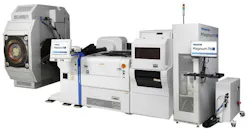
HBM validation now requires coordination across testers, probe cards, handlers, and ESD systems. Test has become a system-level co-design effort, not an isolated manufacturing step.
Looking Forward
AI’s appetite for data will only grow. Memory architectures will follow with more logic content, higher currents, tighter power envelopes, higher speeds, and denser interconnects. Test will not simply react to these changes; it will shape them.
Future ATE platforms will likely incorporate AI-driven analytics to optimize pattern sets, predict weak points, and adapt test conditions dynamically. As packaging becomes more complex, collaboration between design, packaging, and test teams will move earlier in the product cycle.
For designers and test engineers alike, the message is clear: HBM test strategy isn’t a postscript to manufacturing. It’s part of the design. The success of tomorrow’s AI hardware won’t depend solely on how fast it computes, but on how precisely and intelligently it’s tested.
>>Check out this TechXchange for similarly themed articles and videos
promo__id_76795646__cybrain__dreamstimeAbout the Author
 Hanh Lai
Hanh Lai
Director of Memory Marketing, Teradyne
Hanh Lai is Director of Product Marketing for the Memory Test Division at Teradyne, where he owns product definition, positioning, and go-to-market strategy for Magnum memory test products. He has 36 years of experience in the memory test industry, managing application support and product marketing teams.
 Honghui Chen
Honghui Chen
Product Manager, Memory Test Division, Teradyne
Honghui Chen is a Product Manager in the Memory Test Division at Teradyne, where he leads product development for high bandwidth memory (HBM) tester products. He has over 10 years of experience in the semiconductor ATE industry, driving innovative memory testing solutions for AI, HPC, and data center applications.
Comment About the Article
To join the conversation, and become an exclusive member of Electronic Design, create an account today!
 Leaders Logo
Leaders relevant to this article: