Protecting Power Distribution in AI Data Centers
What you’ll learn:
- How AI data centers place new demands on power distribution systems.
- Why dimensional stability is critical for advanced busway designs.
- How PPE resins can help boost insulation performance, processability, and compliance.
- Which other AI data center components can potentially benefit from PPE resins?
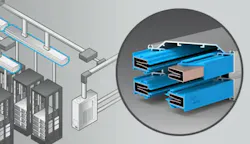
The proliferation of artificial-intelligence (AI) data centers has intensified the need for electrical distribution systems that can handle rapidly fluctuating loads, high power densities, high voltages (800 V DC or more), and elevated temperatures.
To meet these extreme — and variable — power demands, overhead busway systems (Fig. 1) offer AI data centers the potential to be reconfigured and expanded more quickly and efficiently than traditional cable and conduit systems. Furthermore, these modular, self-contained grids can be designed for massive power capacity, high reliability, and even intelligent monitoring.
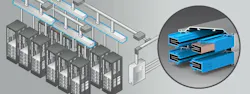
A critical factor in the performance, safety, and scalability of overhead busway systems is the insulation protecting metal busbars that conduct electricity to the data center’s switchgear, transformers, power distribution units, and server racks.
This insulation (Fig. 2) performs multiple functions: electrical isolation, thermal management, and protection from physical damage and environmental exposures. In other words, it’s the first line of defense against electrical faults, short circuits, arc flashes, and human safety risks.
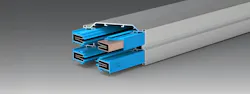
Insulation also plays a role in busway design. It helps facilitate adaptable and scalable power distribution by enabling new servers and other devices to be added or reconfigured without system interruptions, placement restrictions, or requirements for special tooling or expertise.
Effective insulation materials for busway infrastructure must address important trends in AI data centers, which include higher mechanical and electrical requirements, evolving regulations, and escalating pressure to deliver new or expanded infrastructure quickly and cost-effectively.
Insulative polymers used in traditional data center busway systems may be insufficient for the high demands of AI data centers. In the worst cases, inadequate insulation materials could deform or degrade over time, potentially leading to power reductions or interruptions that threaten service-level agreements and the operation of critical data center infrastructure. However, specialty thermoplastics with exceptional properties and processability may enhance the design, performance, and stability of AI data center power-distribution systems.
AI Data Center Power Demands are Different
In contrast to traditional data centers that typically use central processing units (CPUs), AI data centers (Fig. 3) are highly specialized facilities used for AI model training, machine learning, and inference. These processes, which employ specialized, parallel graphic processing units (GPUs), require massive amounts of power. For instance, server racks in traditional data centers typically draw 5 to 15 kW, while AI facilities draw 40 to 100+ kW per rack — and their future power demands may jump to as much as 1 MW per rack.

A row of 10 racks at 40 kW draws over 500 A from the overhead busway. In addition, manufacturers are transitioning to 800-V DC architecture and high-capacity copper busbars to manage extreme current loads and avoid distribution losses. Finally, unlike the predictable power draws of traditional servers, AI data center servers experience intensive power cycling. This volatility is due to rapid shifts from maximum model-training capacity to idle states, which can occur multiple times per minute.
To handle these exceptional power densities, constant power fluctuations, and high voltage levels, the industry is seeking new insulation materials that enable efficient busway designs and exceptional performance for power-distribution architectures.
Better Busway Insulation
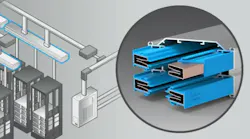
A popular AI data center busway architecture is the open channel (open track) system. It’s comprised of copper or aluminum busbars that are surrounded by insulation to protect them from contact with the metal exterior housing. In this design, the insulation profiles incorporate a continuous access slot for connecting tap-off units to the busbars. These tap-off units deliver power to server racks and other components.
For optimal data center scalability, it should be fast and simple to add or move tap-off units when new server racks or different configurations are required. Ideally, the units can be snapped onto the busway track at the most convenient spots, without special tools or location restrictions.
For this reason, flexible busway designs rely on insulation materials that can be supplied in long, uninterrupted profiles that don’t interfere with the attachment of tap-off units. Insulation materials must be highly dimensionally stable to resist warpage or deformation that can occur when long profiles are exposed to heat and humidity.
Beyond these special design requirements, busway insulation materials need to deliver high mechanical, thermal, and dielectric performance to comply with regulations and meet escalating demands. While glass fiber-reinforced polyamide 66 (PA66) materials have been widely used for conventional data center busway insulation, these resins can fall short in demanding AI data centers.
Design flexibility and easy scalability, combined with enhanced performance, are prompting busway manufacturers to choose dielectric resins based on polyphenylene ether (PPE) technology. These specialty insulative materials, which have been validated by leading busway OEMs, can help meet the escalating challenges of AI data center power-distribution systems.
PPE-Based Resins vs. PA66 Resins in Busway Insulation
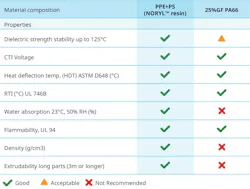
The following list of key properties for busway insulation compares the capabilities of PPE-based materials and glass fiber-reinforced PA66 resins (Fig. 4).
Dimensional stability to maintain precise geometries of long insulation profiles.
PPE-based resins can be extruded into profiles up to 3 meters long without added reinforcement, which PA66 profiles require for stiffness. These PPE resin profiles are rigid and hold tight tolerances, both when extruded and during use. A low coefficient of thermal expansion (CTE) in the range of 50 to 70 µm/m-°C avoids heat-related shape changes. The CTE range for PA66 resins is approximately 60 to 80 µm/m-°C. Also, PPE-based resins feature very low water uptake — 97% less than PA66 resins — to minimize swelling and warpage.
Dielectric strength to help protect against electrical breakdown, arc flash, and contact with live parts.
The dielectric strength of PPE-based resins remains stable over a wide temperature range, enabling these materials to maintain excellent insulative properties. In contrast, the insulative properties of PA66 resins decrease at high temperatures.
Further, PA66 resin’s dielectric insulative performance depends heavily on moisture content. Compared to PPE-based resins, PA66 resins readily absorb water (up to 2.5% by weight in ambient air), which increases their electrical conductivity.
Thermal resistance to withstand high temperatures and meet International Electrotechnical Commission (IEC) 61439 requirements.
To prevent material degradation and warpage under high heat exposure, busbar insulation materials require elevated relative thermal index (RTI) ratings. PPE-based resin RTIs typically range from 110 to 125°C, sufficient for AI data center busway insulation, while PA66 resins with glass fiber reinforcement have RTIs with a wider range, from 100 to 150°C.
Although PA66 resins don’t melt at these high temperatures, their insulative performance decreases. In contrast, PPE resins retain stable insulative properties under exposure to high temperatures.
Flame retardancy for safety and regulatory compliance.
While both PPE-based resins and PA66 materials must be modified with flame-retardant (FR) additives to meet the rigorous UL94 V0 standard, it’s important to choose a grade with a non-brominated/non-chlorinated FR chemistry that avoids halogens or other substances of very high concern (SVHC). This is important to avoid release of corrosive or toxic gases that could harm people or damage AI servers in the event of a fire. Ideally, the material should meet the UL standard at a thin gauge to permit slimmer insulation profiles.
Low density to reduce part weight and material usage.
Compared to glass fiber-reinforced PA66 resins, the lower density of unfilled PPE-based resins can reduce weight for easier busway installation and safer operation. It also helps reduce the amount of resin required in each insulation profile, leading to potential cost and raw material savings.
Easy processing for higher productivity.
Glass-fiber-reinforced polymers like PA66 are significantly harder to process than unreinforced PPE-based resins, which can negatively affect throughput. Unreinforced polymers melt and flow more easily than glass-fiber-reinforced materials, which exhibit high viscosity. They also require specialized, wear-resistant equipment to withstand the highly abrasive fibers.
NORYL PPE Technology: Proven Performance in Busway Insulation
SABIC’s NORYL resin portfolio, celebrating its 70th anniversary in 2026, comprises specialty dielectric materials based on PPE technology. NORYL resins have been validated by leading busway manufacturers and have shown that they can enhance the design and performance of AI data center power-distribution infrastructure compared to PA66 materials, while potentially reducing system costs (Fig 5).
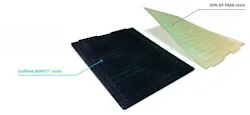
For data on specific properties and processing conditions, and examples of use cases, busway designers and engineers should work directly with specialty resin manufacturers to select the right material for their insulation application.
Other Potential Applications of PPE in AI Data Centers
In addition to busway insulation, PPE-based resins can add value to other components of AI data center power-distribution systems, such as junction boxes and electrical connectors. They also could play an important role in cooling the infrastructure to protect against damage from high and fluctuating temperatures, as well as in generating and storing the vast quantities of electricity needed for data center operations.
Air and Liquid Cooling
Increasingly, PPE-based resins are being used in components like cooling distribution units (CDUs) and pump housings. Their light weight and flame-retardant capabilities (meeting UL94 V0 requirements) address critical safety challenges and reduce physical load in server chassis or rack-mounted heating/ventilation/air conditioning (HVAC) units. These resins also feature a smooth surface that may facilitate liquid flow, reduce energy use by impellers in coolant or water pumps, and avoid biofouling.
Energy Generation and Storage
Access to sufficient electrical power is essential for AI data centers today and into the future. Because traditional utility grid upgrades can take years to complete, some developers are choosing to collocate energy parks that integrate solar and battery storage behind the meter (BTM). This term refers to an onsite power system installed on the customer's side of the utility meter.
To enable these BTM solar installations, PPE materials, such as SABIC’s NORYL V0 resins, can replace heavier, bulkier metal in a range of components, including solar panel frames and microinverters (Fig. 6). These resins offer ease of assembly, exceptional dimensional stability, and broad resistance to UV exposure, harsh environments, and chemicals to prolong part life.
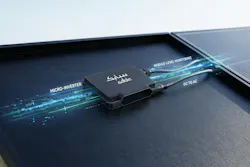
To manage constant fluctuations in power usage, AI data center operators often rely on battery energy storage systems (BESS). These systems can benefit from the lightweight structural support, robust flame retardancy, and high heat resistance of PPE materials.
Value-Added Services and Support
While it’s essential when identifying the right solution for AI data center applications, material selection is only the beginning. To ensure success in application development and operation, customers should collaborate with a supplier that goes beyond materials to offer robust technical services, expertise, and guidance (Fig. 7).
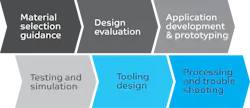
Busway Systems Success Depends on Electrical Insulation Solutions
As the AI juggernaut advances, diverse supporting technologies are being developed and deployed to enable ever more powerful, scalable, and efficient data center infrastructure. Among them are new power-distribution architectures that can handle the unique demands of AI model training, machine learning, and inference, including the ability to withstand high voltages, high power densities, and rapid fluctuations in usage.
Overhead busway systems are proving highly effective in meeting the exceptional power requirements of AI data center servers, but their success depends, in part, upon busbar insulation solutions. Replacing traditional materials with specialty thermoplastics, such as PPE, can enable busway manufacturers to produce insulation that achieves greater performance, stability, and safety, as well as expanded freedom to innovate and scale into the future.
>>Download the PDF of this article
About the Author
 Greg Spangler
Senior Technical Leader, SABIC
Greg Spangler is a senior technical leader for SABIC’s Specialties Business. He focuses on application design and development for high-growth, technology-driven markets including AI data centers. He serves on the Open Compute Project and on the board of the American Injection Molding Institute. Greg earned a master’s degree in engineering from Lawrence Technological University in Southfield, Michigan.
Lauren Bergeron
Senior Manager, SABIC
Lauren Bergeron is a senior manager for Emerging Markets Specification at SABIC’s Specialties Business, where she leads business development initiatives at the forefront of AI data center infrastructure, including power distribution, networking connectivity, and liquid-cooling solutions. Lauren holds a bachelor’s degree in plastics engineering from the University of Massachusetts Lowell and a master’s degree in business administration from Endicott College in Beverly, Massachusetts.
 Kristopher Rexius
Senior Business Manager, SABIC
Kristopher Rexius is the Senior Business Manager for NORYL resin (PPE) at SABIC’s Specialties Business, where he develops and executes portfolio strategies that focus on creating unique customer solutions. Recent developments have focused heavily on differentiated offerings for alternative energy, energy storage, and AI data center infrastructure. Kristopher holds a bachelor’s degree in mechanical engineering from Purdue University in West Lafayette, Indiana, and a master’s degree in business administration from the State University of New York at Albany.
Related
 datacenter_dreamstime_studioclever_323324148

Comment About the Article
To join the conversation, and become an exclusive member of Electronic Design, create an account today!
 Leaders Logo
Leaders relevant to this article: