What’s the Difference Between Hermetically and Environmentally Sealed Connectors?
What you’ll learn:
- What is a hermetically sealed connector and where is it used?
- How is it distinct from an environmentally sealed connector?
- How to evaluate the IP ratings for different connectors.
Connectors used in harsh environments depend on reliable sealing to withstand the elements and deliver excellent performance over the long term. The applications are numerous and varied, from electrical installations exposed to rain and dust to specialist equipment operating under a vacuum with little margin for error, requiring different levels of protection depending on the specific circumstances.
Engineers and technical buyers most frequently turn to hermetically and environmentally sealed electrical and data connectors, each of which has unique benefits that make them appropriate for different applications. Understanding the difference between these two types of connectors is crucial to making the right choice. As is often the case, the most appropriate option ultimately depends on the specific environmental and performance requirements.
What’s a Hermetically Sealed Connector?
A hermetically sealed connector is designed to connect two isolated components of specialized electrical equipment without allowing gases or moisture to leak through.
Glass-to-metal or ceramic-to-metal bonding techniques are typically used to create a gas-tight barrier between the insulating materials and the metallic components, for complete atmospheric isolation. Helium leak testing is applied to verify that the connectors are gas-tight, ensuring extremely low leak rates under vacuum or pressurized conditions.
Hermetically sealed connectors are ideal for use in mission-critical applications, where it’s critical to maintain a stable internal atmosphere, as even minimal gas ingress could compromise performance or safety. Examples include aerospace and defense systems, satellites, vacuum chambers, and certain medical or semiconductor environments.
However, due to the precision construction and stringent performance requirements of these parts, they’re typically more complex and costly than their environmentally sealed counterparts.
What’s Different About Environmentally Sealed Connectors?
While hermetically sealed connectors feature a gas-tight construction, environmentally sealed connectors are only designed to protect electrical contacts from external contaminants, including water, dust, and dirt in outdoor and industrial installations.
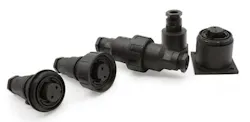
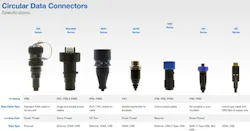
Environmentally sealed connectors such as Bulgin’s Buccaneer range of power and data connectors come with engineered housings, elastomeric seals, and O-rings (Figs. 1 and 2). These features block moisture and particulate intrusion, preventing corrosion, short circuits, or impaired performance. Such connectors are widespread across industrial automation, renewable-energy systems, transportation infrastructure, and marine equipment, where it’s essential to use connectors that can withstand harsh weather conditions for long periods of time.
Many industrial-grade systems favor environmental sealing because it delivers the necessary level of protection without the complexity and cost associated with a hermetic seal.
Understanding Ingress Protection (IP) Ratings
Ingress Protection (IP) ratings are typically used to define environmental sealing. This provides a clear framework for engineers to refer to, making it possible to identify the correct level of dust and water sealing for specific operating conditions.
IP ratings comprise two numbers — for example, IP66 — the first number refers to protection against solid particles, the second to liquid ingress. It’s defined as follows:
Solid particle protection
0. No special protection
1. Protection against solid objects larger than 50 mm in diameter, e.g., accidental touch by hands
2. Protection from solid objects larger than 12 mm in diameter, e.g., accidental touch by fingers
3. Protection from solid objects larger than 2.5 mm in diameter, e.g., tools and wires
4. Protection against 1-mm-wide solid objects, e.g., wires, nails, screws, larger insects, or other items
5. Partial protection against dust, which may be harmful to equipment
6. Full resistance to dust and other small particulates
Liquid protection
0. No protection
1. Protection against dripping water onto item when mounted upright on a turntable and rotated at 1 rep per minute
2. Protection against vertically dripping water when the item is tilted at 15° from its normal position
3. Protection against water spray at any angle up to 60° from vertical, whether that spray is oscillating or has a counterbalanced shield
4. Protection against splashing water from any direction, from an oscillating fixture or one with a spray nozzle with no shield
5. Protection from water jets when water is projected by a 6.3-mm nozzle onto the enclosure from any direction
6. Protection from powerful water jets, i.e., with a 12.5-mm nozzle, projecting water from any direction
6K. Protection from powerful water jets with increased pressure using a 6.3-mm nozzle, projecting water from any direction or elevated pressure
7. Protection from ingress of water in an immersion of up to 1-m depth
8. Protection from ingress of water when immersed depths are higher than 1 m of water
9K. Protection from powerful high-temperature water jets, at close range and at high temperatures
Careful evaluation of the IP ratings for different connectors enables engineers to select the optimum solution for specific applications.
Pros and Cons of Hermetically and Environmentally Sealed Connectors
Although both are designed to protect electrical systems, these connectors differ significantly in construction, performance standards, and intended applications.
Environmentally sealed connectors
- Protect against water, dust, and debris
- Rated using IP standards (e.g., IP67, IP68)
- Ideal for industrial and outdoor environments
- Designed for durability and repeated mating cycles
- Incorporate O-rings and gaskets to create a compression seal
Hermetically sealed connectors
- Create a gas-tight seal
- Validated through helium leak testing
- Suitable for vacuum or pressure containment
- Used in aerospace, defense, and specialized systems
- Usually higher cost due to specialized materials and precision manufacturing processes
When Environmental Sealing is Enough — and When It’s Not
It’s key to identify the primary risks to any electrical systems before deciding which type of sealed connector to use in a particular environment.
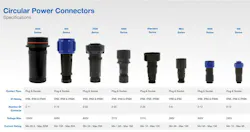
Industrial, renewable energy, transportation infrastructure, and marine systems all operate in environments where protection from rain, washdown, dust, and temperature fluctuations is necessary, but complete atmospheric isolation is not. Environmentally sealed connectors, such as Bulgin’s range of IP66, IP67, IP68, and IP69K power connectors, with the appropriate IP rating work in these situations as they provide protection against ingress of water and particulates, ensuring reliable long-term performance (Fig. 3).
Hermetically sealed connectors are ideal for applications that are unable to tolerate even microscopic gas leakage — typically those involving vacuum systems, pressure vessels, or strict atmospheric containment — ensuring gas-tight integrity. However, it can be important not to employ hermetically sealed connectors at times when environmental sealing is sufficient, as over-specification can increase cost and design complexity.
In the end, hermetically and environmentally sealed connectors are both designed to protect electrical systems, but they serve very different purposes. Hermetic sealing is preferred when a connector needs to be completely isolated from the external environment, giving it the edge in aerospace, defense, satellite, and other mission-critical applications. Environmental sealing grants robust protection against moisture, dust, and other contaminants in applications that still require a high level of reliability and durability – but not so high that hermetically sealed connectors are necessary. Their durable construction also delivers resistance to mechanical stress while maintaining reliable electrical performance for a wide range of industrial applications.
By understanding the differences between these approaches and carefully evaluating the demands of the application, engineers can select the connector technology that delivers the right balance of performance, reliability, and cost.
About the Author
 Tristan Stubbs
Tristan Stubbs
Mechanical Team Leader, Bulgin
Tristan Stubbs joined Bulgin in 2022 as a Mechanical Engineer and was recently promoted to Mechanical Team Leader. He now leads the New Product Development team, designing innovative harsh-environment electrical connectors to expand and enhance Bulgin's product portfolio.
Tristan’s projects have included the release of pre-wired variants of the popular 4000 Series Buccaneer, and the launch of the Single Pair Ethernet series, also housed within the 4000 Series shell. His recent work has been focused on the development and rigorous testing of the new Standard Vitalis Buccaneer series, one of Bulgin’s most significant new product launches in recent years.
Tristan graduated from Aston University with a degree in Design Engineering, and has recently completed a master’s degree in Engineering with the Open University. After finishing his BEng, he worked for a company manufacturing high-purity fluid transfer systems, where he designed bespoke, low-volume assemblies for a range of industries.
Comment About the Article
To join the conversation, and become an exclusive member of Electronic Design, create an account today!
 Leaders Logo
Leaders relevant to this article: