Cortex-M33 Micro Handles Multidrop 10BASE-T1S Ethernet
What you’ll learn:
- What is 10BASE-T1S and why is it important?
- What is the MCX A5 and what are its features?
- How is the MCX A5 changing how industrial and automotive networks are built>
Single-pair Ethernet (SPE) comes in a number of forms, including 10BASE-T1S. They’re being used in a range of industrial, commercial, and automotive applications, often replacing fieldbus and serial bus solutions with an IP-based network that offers advantages in flexibility as well as performance. It allows for the use of Ethernet features like time-sensitive networking (TSN) and MACSEC security.
I talked with Justin Mortimer, Sr. Director of Product Marketing at NXP, about the company’s new MCX A5 microcontroller (see figure). It includes a 10/100 Ethernet MAC and an integrated 10BASE-T1S PHY, enabling it to be a node on a 25-m multidrop IP-based Ethernet network.
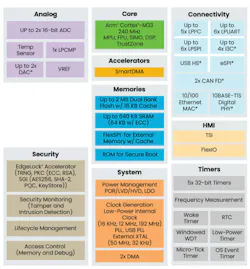
The 240-MHz Cortex-M33 MCX A5 has a few more important features, but the network support is the most significant as it’s one of the first micros with the integrated PHY. Additional circuitry can be added to provide Power over Data Line (PoDL) support. PoDL is different than Power over Ethernet (PoE), but there are a number of similarities.
PoDL is optional and requires additional hardware, but quite a few applications can run off local power. Often a gateway will link the multidrop segment to an Ethernet switch, making it part of a larger IP network.
The MCX A5 includes a security enclave with NXP EdgeLock support. It employs post-quantum cryptography (PQC) that will be required in the future for many of the target applications. The hardware root of trust and secure boot support will maintain a secure system. Secure debugging is supported as well. Tamper and intrusion detection is part of the mix.
The dual-bank, 2 MB of on-chip flash can be augmented by a FlexSPI-based serial memory. The latter includes memory-caching hardware and the interface provides eXecute-in-Place (XIP) support. TSI and FlexIO interfaces feature human-machine interface (HMI) support.
The rest of the peripheral interfaces are common to many NXP microcontrollers: dual 16-bit ADCs, dual DACs, and a built-in temperature sensor and voltage reference (VREF).
Additional communication interfaces include multiple I2C, I3C, SPI, UARTs, and dual CAN FD ports. Timers include a real-time clock (RTC) and a micro-tick timer.
Overall, the MCX A5 family can handle applications from sensors and control systems to motor control and HMI applications tied together via a 10BASE-T2S network.
About the Author
 William G. Wong
William G. Wong
Senior Content Director - Electronic Design and Microwaves & RF
I am Editor of Electronic Design focusing on embedded, software, and systems. As Senior Content Director, I also manage Microwaves & RF and I work with a great team of editors to provide engineers, programmers, developers and technical managers with interesting and useful articles and videos on a regular basis. Check out our free newsletters to see the latest content.
You can send press releases for new products for possible coverage on the website. I am also interested in receiving contributed articles for publishing on our website. Use our template and send to me along with a signed release form.
Check out my blog, AltEmbedded on Electronic Design, as well as his latest articles on this site that are listed below.
You can visit my social media via these links:
- AltEmbedded on Electronic Design
- Bill Wong on Facebook
- @AltEmbedded on Twitter
- Bill Wong on LinkedIn
I earned a Bachelor of Electrical Engineering at the Georgia Institute of Technology and a Masters in Computer Science from Rutgers University. I still do a bit of programming using everything from C and C++ to Rust and Ada/SPARK. I do a bit of PHP programming for Drupal websites. I have posted a few Drupal modules.
I still get a hand on software and electronic hardware. Some of this can be found on our Kit Close-Up video series. You can also see me on many of our TechXchange Talk videos. I am interested in a range of projects from robotics to artificial intelligence.