AI Database Management: ANN Indexes for Resource-Constrained Devices
What you’ll learn:
- What are approximate nearest neighbor (ANN) methods?
- How do ANNs fit with machine learning and artificial intelligence?
- How do ANNs work with embedded databases?

Embedded devices increasingly run machine-learning workloads that search high-dimensional vector embeddings, and these vectors must be searched efficiently under severe resource limits. Traditional database indexes and server-class approximate nearest neighbor (ANN) systems don’t translate directly to microcontroller-class or flash-backed devices. Instead, the design goal becomes controlling data access, memory use, and predictable latency rather than maximizing raw recall or throughput.
ANN Strategies Adapted for Embedded Constraints
ANN methods are attractive because they limit how much of the dataset is touched during a query by accepting bounded approximation. Two broad families are emphasized:
- Proximity graphs (hierarchical navigable small world or HNSW, Vamana): Connect each vector to a small set of neighbors and perform graph walks at query time. Graphs can be tuned to bound memory (parameters like M, efSearch), but traversal cost and non-sequential flash reads remain workload dependent.
- Clustered partitions (inverted file or IVF): Group vectors into clusters with centroids kept in RAM; queries probe a small number of clusters (nprobe) and scan only those partitions. This gives predictable top-level filtering and reduces flash I/O when cluster contents are stored sequentially.
A practical embedded design often combines both: Use IVF to select a bounded subset, then run a graph-based search (HNSW or similar) inside those clusters to refine results. This hybrid reduces non-sequential accesses and lets designers trade recall for bounded latency by tuning nprobe and efSearch.
Compression and the Importance of Data Movement
On constrained devices, the dominant cost is often data movement from flash, not just index metadata. Two compression strategies are central:
- Product quantization (PQ): Split vectors into sub-vectors and quantize each part; store compact codes and estimate distances cheaply during search (Fig. 1).
- Scalar quantization (SQ): Reduce per coordinate precision (e.g., 8 bit), simpler but usually less accurate than PQ.
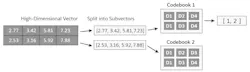
Quantization reduces flash reads and lets more of the working set fit in RAM, improving latency and predictability. Typical practice is to quantize offline and operate on compressed codes during lookup, optionally re-scoring a few top candidates with full vectors if higher accuracy is needed.
Index Construction Belongs Offline
Building ANN indexes — especially graph-based ones — requires substantial memory and CPU: IVF clustering (Fig. 2) needs repeated scans and layout planning; graph construction (HNSW, Vamana) requires many candidate evaluations and temporary structures.
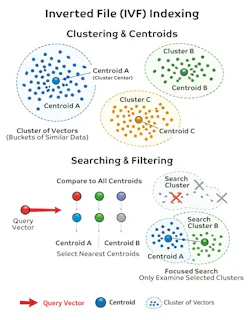
Embedded targets usually can’t perform these builds in situ, so index construction is done offline on more capable machines, with the finished index and carefully planned storage layout deployed to the device. This offline step also makes it possible to arrange cluster contents sequentially on flash to minimize random reads at query time.
Practical Architectures and Tradeoffs
IVF only:
- Pros: Tiny centroid table in RAM; predictable top-level cost; good when cluster layout is optimized for sequential reads.
- Cons: Coarse approximation; must probe multiple clusters to avoid misses, increasing I/O.
HNSW only:
- Pros: Graceful degradation under cache pressure; tunable memory footprint via M and efSearch.
- Cons: Graph traversal can cause many non-sequential flash reads; vector accesses often dominate cost.
Vamana / DiskANN style
- Pros: Designed for disk/SSD; sparse directed graphs with bounded neighbors.
- Cons: Sensitive to cache size — performance collapses when the working set no longer fits in RAM.
Hybrid (IVF + Graph)
- Pros: Best practical balance for embedded: IVF bounds the search scope; graph refines within that scope; parameters let you trade recall for bounded latency and I/O.
- Cons: Added complexity in offline build and coordinated updates; still an approximation with potential misses if clustering is imperfect.
Empirical Observations on Flash Systems
Tests comparing HNSW and Vamana on disk-based datasets show that page size and cache size matter. Smaller pages improve locality and delay performance degradation as RAM shrinks. HNSW degrades gradually as cache misses increase, while Vamana performs well only when the working set fits in cache and then drops sharply once it does not. Thus, Vamana is less robust on very constrained devices.
Importantly, the dominant cost in these tests was index traversal and page access, not the size of returned data, underscoring that I/O patterns drive performance on flash.
Recommendations for Embedded Deployments
- Treat ANN as a full stack problem: Tune index parameters, DBMS layout, and storage access together rather than in isolation.
- Build offline and optimize layout: Construct clusters and graphs on a server, then place cluster contents sequentially on flash to minimize random reads.
- Compress aggressively: Use PQ or SQ to reduce flash I/O and fit more working sets in RAM; re-score only a few candidates with full vectors when necessary.
- Prefer hybrid IVF+graph designs for MCU class systems to bound the number of vectors touched and make latency predictable.
- Tune for predictability, not peak recall: In safety- or latency-critical embedded systems, bounded execution and predictable I/O are often more important than marginal gains in recall.
Conclusion
ANN indexing can be made practical on resource-constrained devices, but only when designers accept approximation and control the entire stack: index structure, compression, DBMS layout, and storage access patterns. Hybrid approaches that combine coarse partitioning (IVF) with local graph navigation (HNSW or similar), built offline and stored in compressed form, offer the best path to predictable, low-latency vector search on flash-backed embedded systems.
Without these coordinated choices, server class ANN techniques risk unpredictable latency and excessive I/O on small devices — an outcome that embedded systems cannot tolerate.
About the Author
 Steven Graves
Steven Graves
President and CEO, McObject
Steven Graves co-founded McObject in 2001. As the company’s president and CEO, he has both spearheaded McObject’s growth and helped the company attain its goal of providing embedded database technology that makes embedded systems smarter, more reliable, and more cost-effective to develop and maintain.
Prior to McObject, Mr. Graves was president and chairman of Centura Solutions Corporation, and vice president of worldwide consulting for Centura Software Corporation; he also served as president and chief operating officer of Raima Corporation. He’s a member of the advisory board for the University of Washington’s certificate program in Embedded and Real Time Systems Programming.
For Steve’s updates on McObject, embedded software and the business of technology, follow him on Twitter or LinkedIn.
Related
 smartfactory_dreamstime_l_126723440
Comment About the Article
To join the conversation, and become an exclusive member of Electronic Design, create an account today!
 Leaders Logo
Leaders relevant to this article: