Infineon Bets on Smart Power with New Semiconductor Fab

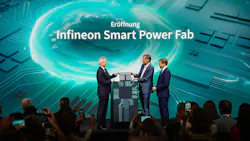
Infineon Technologies opened a major new semiconductor plant in Dresden, Germany, investing about $5.5 billion to build what the company calls the world’s largest fab for intelligent power, analog, and mixed-signal technologies.
The Smart Power Fab, which opened several months ahead of schedule, is the largest investment in the company’s history. Infineon said the new fab doubles the 300-mm manufacturing capacity at its Dresden site. Chips made there will support the efficient supply of power to AI data centers, among other things. The chips are also intended for use in automotive and industrial applications, from electric grids and wind, solar, and renewable energy systems to software-defined vehicles.
“We're opening our new plant at just the right time," said CEO Jochen Hanebeck. He added that the fab is “creating urgently needed capacities for the key technologies of the future, for everything from energy supply for AI data centers to software-defined vehicles and renewable energies. Infineon is thus giving an important impulse in making the global AI revolution possible and securing supply chains in critical industries.”
The fab will produce intelligent power switches that not only control the loads but also monitor power flow. While MOSFETs and other power switches usually pair up with separate gate drivers and protection circuitry, these smart power switches consist of a power FET, control logic, and protection features in a single device. That allows for more advanced functionality such as overcurrent, overvoltage, and overtemperature protection, along with diagnostics that identify what caused the fault.
The fab will also manufacture smart power stages used in multiphase voltage regulators that are critical to AI power delivery. These devices combine high- and low-side MOSFETs, gate driver, and high-precision temperature and current sensing into a single package to power rails flowing into processors, memory, and more. Smart power stages combine with a multiphase digital controller to create a full DC-DC converter that can handle the very high currents required by GPUs and other AI chips at low voltages.
Besides data centers, smart power stages are widely used in automotive and industrial applications, including humanoid robotics, said Infineon.
The Start of a New Upcycle for Power Semiconductors?
The move comes during a significant upcycle in demand for power and power-adjacent semiconductors, creating the tightest market conditions in years, said Brendan Burke, a technology analyst at The Futurum Group.
He explained that Infineon and other suppliers, including Texas Instruments and Renesas Electronics, have been through several rounds of price increases for power and analog chips in recent months, usually 10% to 25% at a time. Prices for some high-end server power components have reportedly jumped even higher than that.
“The Dresden opening shows confidence in the durability of power semiconductor demand and on the pricing power that demand currently confers,” Burke said in a research note.
The momentum is mostly driven by the AI boom. Power stages, for instance, are key components for regulating power efficiently, minimizing losses and limiting heat generation. As AI racks become increasingly power-dense, every subsystem — from processors and memory to networking silicon — requires extra power stages, leading to high unit volumes per server. Given that, the power stage segment projects to be the largest in the $265 billion data center chip market by 2029, according to MarketsAndMarkets.
The research firm said that data centers are also driving up demand for multichannel ADCs and DACs. These chips enable precise, real-time monitoring and control, increasingly required in complex, power-dense AI systems. They’re used to monitor multiple analog signals at the same time — including current, voltage, temperature, and even airflow — in everything from server power-supply units (PSUs) to forced-air and liquid-cooling systems.
Multichannel ADCs efficiently convert these analog inputs for the purposes of system protection and reliability, while DACs enable nuanced control of power and thermal management. More advanced power designs, including 400- and 800-V DC bus architectures, require high-channel-count data acquisition to improve accuracy and speed. Compared to single-channel solutions, multichannel ADC and DACs have higher levels of integration and fit into smaller form factors.
Infineon anticipates AI-related power solution revenue to grow from roughly $1.8 billion in 2026 to $2.9 billion in 2027. To stay a step ahead of the market, the power-electronics giant also plans to invest close to $600 million in additional funds to increase capacity.
The “Smarts” Inside the Smart Power Fab
Power-hungry AI hardware is creating other ripple effects, too. According to Futurum, constraints on connecting new data centers to the electric grid could force more than a third of them off the grid by 2030. That would deepen the need for efficient on-site power conversion as well as intelligent power electronics used in on-site renewable sources. It would be a boost for battery energy storage systems (BESS) and the mixed-signal, multicell battery-management ICs tucked inside them.
“Every AI rack multiplies demand for the voltage regulators, gate drivers, and power switches Dresden is built to make,” said Burke. “The demand curve for power and analog content is being reset upward by AI, on top of the slower structural pull from electrification and software-defined vehicles.”
Infineon said the smart power fab leverages digital technologies that allow it to ramp up production twice as fast as before, depending on demand. For instance, the shell of the facility and the layout of the equipment inside were planned and optimized using a digital twin, while AI is used to support system and process validation. According to Infineon, the faster ramp-up will help it cash in on current demand and reach volume before future waves crest.
The company also said the smart power fab is digitally connected to its Villach plant, creating a single "virtual fab” that facilitates faster qualification of new process technologies and products.
About the Author
 James Morra
James Morra
Senior Editor
James Morra is the senior editor for Electronic Design, covering the semiconductor industry and new technology trends, with a focus on power electronics and power management. He also reports on the business behind electrical engineering, including the electronics supply chain. He joined Electronic Design in 2015 and is based in Chicago, Illinois.
Comment About the Article
To join the conversation, and become an exclusive member of Electronic Design, create an account today!
 Leaders Logo
Leaders relevant to this article: