A Voltage Regulator to Keep Pluggable Optics Plugging Away

What you'll learn:
- Inside a new solution for accurate voltage regulation with a DC accuracy of ±0.25% at up to 24-A output current.
- Why fast transient regulation makes the switch-mode power supply well-suited for optical transceivers and memory applications.
- How it achieves fast load transient regulation and how a graphical user interface can be used to digitally communicate with the power supply via PMBus.
Many power-supply ICs are designed to work with a wide range of applications. However, some applications require precisely controlled voltages at high currents, calling for a more tailor-made power-supply solution.
Optical transceivers in data centers, for instance, require a unique power supply. Load transients must be regulated quickly to ensure that the supply voltage deviates only slightly from its nominal value. This is also the case for DRAM and other memory chips, which are evolving to use lower supply voltages. All in all, meeting these requirements is a challenging task for a power supply. Figure 1 shows the application of an optical transceiver in a wireless communication system or data center.

These applications tend to have special requirements for supply-voltage accuracy. The switch-mode power supply (SMPS) in Figure 1 generates the voltage for the optical transceiver. The buck converter features a DC accuracy of ±0.25% over the entire permissible temperature range of –40 to +150°C when the output voltage is set between 0.6 and 1.375 V.
The wide temperature range is necessary because power electronics in data centers are often packed as tightly as possible. While these power converters have high efficiency, they still dissipate some power as heat, which can raise the temperature of the circuit to very high levels.
In data centers, optical transceivers act as the physical bridge between server racks. They convert electronic bits into photons, flinging them through fiber optics and turning them back into electronic signals on the other side. As AI drives the demand for massive clusters of GPUs and other accelerators, these transceivers are increasingly key to connecting them with low latency and high bandwidth. But they also have finicky power requirements.
As transceiver speeds surge from 400G and 800G to 1.6T, the power density of pluggable optics is rising, too. For OSFP optical modules, typical power consumption is increasing from about 16 W for 800G modules to the 25 W range for 1.6T, requiring increasingly power-hungry parts to fit into already tight form factors. Multiply that by thousands of modules plugged into networking switches sitting on top of racks, and the technology is rapidly becoming a power hog.
But supplying all that power efficiently is only part of the challenge. The power must also be clean and stable. The digital signal processor (DSP) at the heart of the transceiver requires tight voltage regulation and fast transient response times. Slow or noisy voltage regulators can impact the integrity of the transceivers’ signals or cause disruptions that can prolong already costly training runs for large language models (LLMs). — James Morra, Senior Editor, Electronic Design
For accurate control, it’s important to ensure high accuracy for load transients in addition to DC accuracy. These can be achieved with a fast control loop of the voltage converter and with many high-quality output capacitors. But since these capacitors can be costly and take up valuable space, engineers often attempt to speed up the regulation of the power supply.
On-Time Valley Current-Mode Control
In the LT7176, fast control is achieved by an on-time valley current-mode control (Fig. 2). Compared to other solutions, an approximate 30% reduction in the overshoot and undershoot of the output voltage can be attained thanks to load transients.
To limit electromagnetic interference (EMI) without limiting efficiency, the device leverages Analog Devices' Silent Switcher technology to enable fast switching transients with very low radiated emissions. The fast switching transitions lead to low switching losses of the power supply. As a result, it can operate a high switching frequency of up to 3 MHz without experiencing excessive losses.
To further reduce output-voltage ripple, a variant of the LT7176 can be used: The LT7176-1 is almost identical, featuring a pair of phase-shifted channels with the same maximum output current of 24 A. However, two inductors are required for this solution. The advantage is that these inductors only need to handle half the total power; therefore, engineers can specify devices with a lower overall height. The vertical space savings can be helpful for applications that are limited in height.
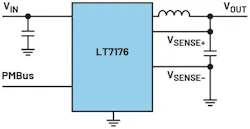
In addition to accurate voltage regulation, high reliability of voltage conversion is important. Using a digital connection of the LT7176, the state of the input and output voltage, input current, device temperature, and other fault states and operating conditions can be queried.
It’s also possible to execute various settings of the device through the existing PMBus connection. This includes setting the output voltage, a current limit, switching on and off, soft start and soft stop, and many other parameters such as control-loop compensation.
Figure 3 shows the graphical user interface LTpowerPlay, which allows the circuit to be evaluated and configured with different settings.

Despite the many different SMPS ICs on the market, there are always applications where only a specialized solution can fully meet the requirements. The LT7176 and LT7176-1 present a new solution offering high output currents and control accuracy with low converter losses and low radiated emissions, as well as advanced control through digital interfaces.
>>Download the PDF of this article
 dreamstime_sittisakmonrittinupap_417250950
About the Author
 Frederik Dostal
Frederik Dostal
Power-Management Technical Expert
Frederik Dostal is a power-management expert with more than 20 years of experience in this industry. After his studies of microelectronics at the University of Erlangen, Germany, he joined National Semiconductor in 2001, where he worked as a field applications engineer, gaining a lot of experience in implementing power-management solutions in customer projects. During his time at National, he also spent four years in Phoenix, Arizona (USA), working on switch-mode power supplies as an applications engineer.
In 2009, he joined Analog Devices, where since then he held a variety of positions working for the product line and European technical support, and currently brings in his broad design and application knowledge as a power-management expert. Frederik works in the ADI office in Munich, Germany.
Also check out my: