AI Glasses are Running into a Heat Problem
What you'll learn:
- Why heat — not computing power — is the biggest design challenge for AI smart glasses and how it limits performance.
- How always-on smart glasses create new thermal challenges that passive cooling alone can no longer address.
- How MEMS-based micro-cooling technology can solve the challenge by directing air to the worst hot spots.

Eventually, every computing platform encounters a physical limit. For smart glasses, that limit is heat.
These devices are evolving into always-on AI assistants capable of real-time translation, contextual awareness, and seamless layering of digital objects and data on top of the physical world. In contrast to smartphones, which are typically used intermittently, these AI glasses are designed for continuous, battery-powered operation. They must sustain demanding workloads for hours while resting directly on the user's face, placing the source of heat closer to them than almost any other consumer device.
The differences between smart glasses and other computing platforms create a set of new engineering challenges. Power must be sustained over extended periods, while the resulting heat has to be managed in a device that remains in constant contact with the user.
For AI glasses, the most advanced hardware is only as effective as the user's willingness to wear them throughout the day.
Thermal Limits of Skin-Contact Designs
Wearables, including devices like smartwatches, fitness bands, and wireless earbuds, operate under a different set of thermal constraints than most consumer electronics. AI glasses take the same constraint a step further since they sit on highly sensitive areas like the nose bridge and temples, where even minor temperature increases are immediately felt.
As a result, industry safety standards typically cap surface temperatures for skin-contact devices at around 48°C. In practice, product teams aim closer to 41°C to 42°C to maintain comfort over extended wear. Within that narrow range, every watt of power and every incremental rise in temperature must be carefully controlled.
When it comes to AI glasses, thermal management has become a core focus for engineers. The frame provides a limited surface area for heat dissipation and very little internal volume to absorb it. In addition, these devices are expected to run constantly, often at elevated temperatures or in direct sunlight, with no opportunity to cool down. Therefore, heat builds quickly, and once the frame nears its threshold, the system must compensate for it by reducing performance or limiting functionality.
This tradeoff is already evident in current products. For example, high-resolution video capture is often time-limited. As cameras, sensors, and processors work simultaneously, the system approaches its thermal ceiling and adjusts to remain within safe and comfortable limits. In practice, the user experience is shaped by heat as much as by software capability.
How AI Changes the Thermal Challenge
Traditionally, passive cooling strategies, including heat spreaders, graphite layers, and thin metal frames, worked well enough for wearable devices. However, distributing heat across the device and releasing it slowly into the surrounding air proved to be a suitable approach for intermittent workloads and lower power levels.
Now, AI has introduced more demanding operations such as on-device inference, real-time computer vision, and continuous sensing that keeps processors active for longer periods. Instead of shorter bursts followed by relatively long periods of down time, the system now works closer to a steady state. Heat remains elevated since the device rarely has a chance to cool.
The situation is complicated by the small, lightweight form factor of smart glasses, which come with limited surface area for heat dissipation and little mass to absorb heat spikes. Weight constraints further limit the use of heatsinks and other large passive-cooling components, as every added gram impacts comfort and wearability. Consequently, the system can reach its thermal limits very quickly and stays close to them during sustained use.
Why Heat Spreading isn’t Enough
Most thermal solutions in compact electronics rely on conduction, moving heat away from the source and distributing it across a larger area. Materials such as graphite sheets and vapor chambers are highly effective in these situations.
Once heat reaches the device surface, convection takes over. In still air, a thin layer of warm air forms around the glasses frame, which slows the transfer of heat into the surrounding environment. This boundary layer becomes a bottleneck, restricting how quickly heat can dissipate.
At that stage, further improvements in conduction offer diminishing returns and the real challenge becomes removing heat efficiently from the surface. In AI glasses, where airflow is limited and space is constrained, this bottleneck emerges quickly. System performance depends on how effectively heat can be carried away from the frame, not just distributed within it.
Why Smart Glasses are Hot All Over
The processor is only one part of the thermal challenge. As AI glasses become more advanced, they’re adding cameras, sensors, wireless radios, and augmented-reality (AR) display engines, all of which generate heat and are bunched together within the same tightly constrained frame. In AR glasses, the light engine projects images into the lens — itself another sustained heat source — often just millimeters from the processor.
These components compound one another's thermal impact. As internal temperatures rise, performance begins to degrade due to dropping frame rates, changes in image quality, and a decline in system responsiveness. At the same time, external frame temperatures can become uncomfortable for the wearer. Internal performance and external wearability must be balanced within the same limited thermal envelope.
Micro-Cooling Fans that Fit into Tight Spaces
One way to improve thermal performance in AI glasses is to better redistribute heat away from where it causes the most damage to where it causes the least. However, the future increasingly hinges on removing heat efficiently from the system, introducing airflow into a form factor that has long operated without it.
Traditional fans aren’t a viable option. They take up space, produce audible noise, and rely on mechanical components that wear over time, making them unsuitable for compact, lightweight eyewear.
Solid-state micro-cooling, like solutions pioneered by xMEMS, offers a different path (see figure). By generating directed airflow at the millimeter scale, these systems introduce convection precisely where it’s needed — at the heat source and along the frame’s thermal path.
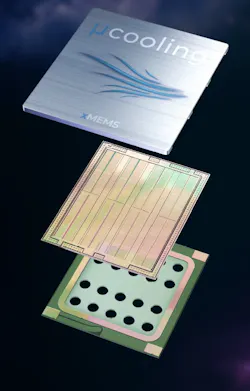
Within the temple arm, that can take the form of a controlled airflow channel. Air enters through a small inlet, is guided across heat-generating components, and expels through an outlet at the end of the frame. The result is continuous, silent, and targeted air flow.
What makes this effective is placement. Even relatively small amounts of airflow, applied at the right place, can significantly reduce both internal component temperatures and the heat felt at the surface.
Today, high-resolution video capture, continuous AI processing, and extended camera use are often limited to short durations in AI glasses or dynamically adjusted to stay within safe operating temperatures. But as thermal headroom improves, those boundaries expand. Features that were previously restricted can now operate for longer durations. AI assistants are able to stay active throughout the day, and real-time processing becomes more stable and predictable.
Micro-Cooling Engineered for Always-on Computing
The success of AI glasses depends on sustaining performance in a form factor designed first and foremost for comfort. That balance is defined by the underlying thermal architecture.
Micro-cooling complements existing thermal strategies by enabling controlled heat removal at a scale suited to eyewear. It introduces a capability that passive solutions alone can’t deliver, supporting a more balanced and resilient thermal system.
Increasing compute density and the addition of new capabilities will continue to ramp up heat generation within the frame. Managing it all requires a layered approach: conductive materials to spread heat across the structure, combined with targeted airflow to actively remove it from the system. As AI glasses move from early products into mass-market devices, thermal design will become a key difference maker for both performance and real-world usability.
>>Download the PDF of this article, and check out the TechXchange for similarly themed articles and videos
 background_dreamstime_mkmult_329176844
 Promo Roman Snytsar Dreamstime Xxl 7193023
About the Author
 Mike Housholder
Mike Housholder
VP Marketing and Business Development, xMEMS Labs
Mike Housholder, VP of Marketing and Business Development at xMEMS Labs, is a 24-year technology product/business executive who has built multiple $100M+ industry-first businesses from the ground-up in mobile systems, MEMS sensing, wireless networking and storage encompassing software/apps/APIs/algorithms/mobile OS, semiconductors and cloud.
Comment About the Article
To join the conversation, and become an exclusive member of Electronic Design, create an account today!
 Leaders Logo
Leaders relevant to this article: