UCIe 4.0 Standardizes Memory Connectivity
What you’ll learn:
- What’s new in the UCIe 4.0 standard?
- What is UCIe.mem?
- How to manage chiplets using UCIe.
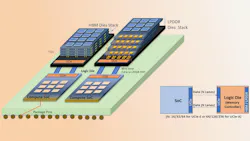
The Universal Chiplet Interconnect Express (UCIe) Consortium’s new UCIe 4.0 specification enhances memory and management support for chiplets, building on the success of UCIe 3.0 (see table). It’s designed to deliver approximately 2.5-TB/s/mm die-edge bandwidth density. The new co-optimized link profiles boost energy efficiency by 30% to 80%. The improved UCIe-S bump map for 48 GT/s and 64 GT/s are designed to increase shoreline by about 20% and bandwidth by about 10% with a smaller die footprint.
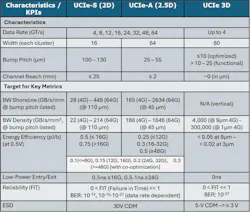
UCIe 4.0 Memory Improvements with UCIe.mem
UCIe 4.0 adds a new protocol called UCIe.mem based on the current PHY. It’s designed to provide the 2.5-TB/s/mm bandwidth density while providing data efficiency as high as 93.75%.
“The newly released specification also gives designers new ways to improve system efficiency, including an optional power-optimized profile that delivers up to 30% to 80% greater energy efficiency at 64 GT/s and an enhanced bump map for UCIe-S 48 GT/s and 64 GT/s that increases bandwidth density while reducing the shoreline needed for high-speed die-to-die connectivity. The enhanced bump map provides approximately 20% greater shoreline bandwidth density and 10% greater area bandwidth density, letting designers achieve higher bandwidth in a given footprint or free package resources for other system needs.”
UCIe.mem defines protocol encodings that pack memory requests and responses within UCIe flits (flow control units) while minimizing protocol overhead. For example, it can pack two memory requests or four memory responses into a 16-byte slots of a 256-byte flit, significantly reducing header overhead, acknowledgments, reliability mechanisms, and flow-control information.
Secure Management with UCIe 4.0
The addition of Trusted Reporting of Chiplet State (TRoCs) provides secure communication of a chiplet’s state. This protects a system from manipulated state information issues as well as spoofing attacks.
The management support lets developers optimize bandwidth and configure power and memory resources across die and packages. The new standard adds two-way, secure management channels. This offers a standard way to manage chiplets from different sources using a common management subsystem.
New management features like enhanced reset management and optional error notifications in addition to link-health monitoring are useful in general. However, they’re required for functional-safety applications like automotive and aviation that must meet safety and reliability standards.
More About UCIe






About the Author
 William G. Wong
Senior Content Director - Electronic Design and Microwaves & RF
I am Editor of Electronic Design focusing on embedded, software, and systems. As Senior Content Director, I also manage Microwaves & RF and I work with a great team of editors to provide engineers, programmers, developers and technical managers with interesting and useful articles and videos on a regular basis. Check out our free newsletters to see the latest content.
You can send press releases for new products for possible coverage on the website. I am also interested in receiving contributed articles for publishing on our website. Use our template and send to me along with a signed release form.
Check out my blog, AltEmbedded on Electronic Design, as well as his latest articles on this site that are listed below.
You can visit my social media via these links:
- AltEmbedded on Electronic Design
- Bill Wong on Facebook
- @AltEmbedded on Twitter
- Bill Wong on LinkedIn
I earned a Bachelor of Electrical Engineering at the Georgia Institute of Technology and a Masters in Computer Science from Rutgers University. I still do a bit of programming using everything from C and C++ to Rust and Ada/SPARK. I do a bit of PHP programming for Drupal websites. I have posted a few Drupal modules.
I still get a hand on software and electronic hardware. Some of this can be found on our Kit Close-Up video series. You can also see me on many of our TechXchange Talk videos. I am interested in a range of projects from robotics to artificial intelligence.

Comment About the Article
To join the conversation, and become an exclusive member of Electronic Design, create an account today!
 Leaders Logo
Leaders relevant to this article: