Electronic Design Weekly: Sept. 21, 2026 - AI Backlash
In This Issue
- Editorial: History, Hoarding, and Hugging Face
- Are You Using ROS 2?
- Feedback Loop
- Featured Content
- New Products
- Robotic Software
- Multimedia on ElectronicDesign
- Editor's Choice: From the ElectronicDesign Archives
- Editor's Weekly Picks
- Illustrated Engineering
- Word of the Week
- New in Electronic Design's Member Library
- More Electronic Design Weekly
Welcome to Electronic Design's weekly publication where you can find the latest articles, videos, and podcasts. Think of it as Electronic Design magazine where you can read about the latest technologies and products.
Physical AI is the new buzzword for mobile robotics. This week we focus on robotc software for applications like physical AI, including platforms such as the Robotic Operating System (ROS). ROS 2 is the latest incarnation. As it turns out, it can be used for more than just humanoid robots. Our Word of the Week is focused on robots and drones as well.
On the other hand, my editorial deviates a bit, focusing on not just robotics, but also AI and its place in history.
Check back as we add more content every day. You can sign up for our daily newsletter to see the latest articles as they're posted. Check out the latest newsletters. You can also check out archived versions of Electronic Design Weekly.

Editorial: History, Hoarding and Hugging Face
I've always loved studying history, even though I didn't always do great in those classes because they were more about memorizing dates and names. What I found interesting was the relationships. It's probably one reason I love to read alternate universe sci-fi like Eric Flint’s 1632 (free download from Baen Publishing). For me, it inspires research into what really happened.
Those who forget history are condemned to repeat it
- The Life of Reason, or The Phases of Human Progress | George Santayana
This editorial was originally going to be about the Robot Operating System and its importance to physical AI software, but the latest news flurry about controlling escaping AI models changed that. Robots, drones, and physical AI are also in the news as AI is now an integral part of these devices. However, the problem isn't limited to these.
Continue reading the rest of this editorial.
 Raspberry Pi
 Edge Awards
 roboticarm_dreamstime_l_342278242
 promo_4_collage
 mobilerobot_dreamstime_l_314282258
 dreamstime_biancoblue_330637634_2
 Globe and video wall
Here are some podcast and videos related to our focus this week: The Robot Operating System (ROS).
Editor's Choice: From the ElectronicDesign Archives
These articles were chosen by the editors at ElectronicDesign that complement the new articles above. They’re included in our regular newsletters.
 Kioxia Promo
 Pexels Tima Miroshnichenko 5380642 Promo
Andy's Picks from Around the Web
VinFast unveils VF Wild pickup truck as its first EREV. Link
Boston Dynamics Opens Robotics Metaplant Application Center to Train Humanoid Robots for Manufacturing Tasks. Link
Samsung accidentally freezes its smart fridges with a software update. Link
Next-Gen BYD Seagull Could Bring MW Flash Charging to Brand’s Cheapest EV. Link
US chip fabs face massive 157,000 worker shortfall. Link
Zuckerberg, Musk And Huang Reportedly Convinced Trump To Block AI Regulator. Link
Andy's Video Pick of the Week
An interesting little 3d display project that'll have you scratching your head on how it works.
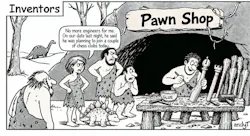
From the Inventors comic collection.
My illustrator was being a complete moron and after a half hour of prompting, I gave up on modifying the second guy to the left of Rocks-anne to look disgusted at Joel, our engineer behind the bench. Instead, the Ai gave me a disrespectful incel who completely ignores what she is saying (and maybe that's the real joke in this cartoon? The news headlines do point to an unfavorable woman bias inherent in AI).
There are other flaws, but are not worth me putting in the more than 50 minutes it took to get it to go this far because AI wrecks what it created in such changes, even if you prompt it to freeze what's there with a well constrained exception. An example is the leash terminating in the pet's butt vs being correctly attached to the collar in the prior iteration - after it was admonished for doing so several iterations prior (pets' owners...friends or enema?)
Engineering on Friday!
I draw all my cartoons by hand. I don't often fight with myself, but when I do it often ends in an uneasy truce. Shattered, but I carry on…
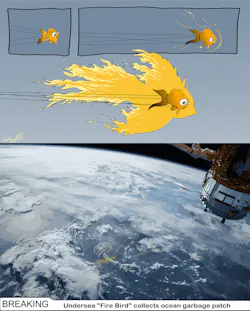
This is the last of my “joke that turned into an environmental campaign.” It also features my favorite fish of all time, Goldie Fishwater. I built a whole internet controlled fishtank project for her. Best of all, I enshrined her life story in the project video. Take a watch after this link.
New in Electronic Design's Member Library
Are you an Electronic Design member? It’s free and you get access to content like our latest eBooks and editorial webinars. You can also provide feedback about articles.
 promo
promo Reading library book

 ED Weekly 9-14-26
 Electronic Design Weekly
About the Author
 William G. Wong
William G. Wong
Senior Content Director - Electronic Design and Microwaves & RF
I am Editor of Electronic Design focusing on embedded, software, and systems. As Senior Content Director, I also manage Microwaves & RF and I work with a great team of editors to provide engineers, programmers, developers and technical managers with interesting and useful articles and videos on a regular basis. Check out our free newsletters to see the latest content.
You can send press releases for new products for possible coverage on the website. I am also interested in receiving contributed articles for publishing on our website. Use our template and send to me along with a signed release form.
Check out my blog, AltEmbedded on Electronic Design, as well as his latest articles on this site that are listed below.
You can visit my social media via these links:
- AltEmbedded on Electronic Design
- Bill Wong on Facebook
- @AltEmbedded on Twitter
- Bill Wong on LinkedIn
I earned a Bachelor of Electrical Engineering at the Georgia Institute of Technology and a Masters in Computer Science from Rutgers University. I still do a bit of programming using everything from C and C++ to Rust and Ada/SPARK. I do a bit of PHP programming for Drupal websites. I have posted a few Drupal modules.
I still get a hand on software and electronic hardware. Some of this can be found on our Kit Close-Up video series. You can also see me on many of our TechXchange Talk videos. I am interested in a range of projects from robotics to artificial intelligence.
 Roger Engelke Jr.
Roger Engelke Jr.
Managing Editor - Electronic Design and Microwaves & RF
Roger manages the websites and print issues for Electronic Design and Microwaves &RF.
 Cabe Atwell
Cabe Atwell
Technology Editor, Electronic Design
Cabe is a Technology Editor for Electronic Design.
Engineer, Machinist, Cartoonist, Maker, Writer. A graduate Electrical Engineer actively plying his expertise in the industry and at his company, Gunhead. When not designing/building, he creates a steady torrent of projects and content in the media world. Many of his projects and articles are online at element14 & SolidSmack, industry-focused work at EETimes & EDN, and offbeat articles at Make Magazine. Currently, you can find him hosting webinars and contributing to Electronic Design and Machine Design.
Cabe is an electrical engineer, design consultant and author with 25 years’ experience. His most recent book is “Essential 555 IC: Design, Configure, and Create Clever Circuits”
Cabe writes the Engineering Life & Engineering on Friday blog on Electronic Design.
See Cabe's cartoons & comic strips here.
 James Morra
James Morra
Senior Editor
James Morra is the senior editor for Electronic Design, covering the semiconductor industry and new technology trends, with a focus on power electronics and power management. He also reports on the business behind electrical engineering, including the electronics supply chain. He joined Electronic Design in 2015 and is based in Chicago, Illinois.
 Andy Turudic
Andy Turudic
Technology Editor, Electronic Design
Andy Turudic is a Technology Editor for Electronic Design Magazine, primarily covering Analog and Mixed-Signal circuits and devices and also is Editor of ED's bi-weekly Automotive Electronics newsletter.
He holds a Bachelor's in EE from the University of Windsor (Ontario Canada) and has been involved in electronics, semiconductors, and gearhead stuff, for a bit over a half century. Andy also enjoys teaching his engineerlings at Portland Community College as a part-time professor in their EET program.
"AndyT" brings his multidisciplinary engineering experience from companies that include National Semiconductor (now Texas Instruments), Altera (Intel), Agere, Zarlink, TriQuint,(now Qorvo), SW Bell (managing a research team at Bellcore, Bell Labs and Rockwell Science Center), Bell-Northern Research, and Northern Telecom.
After hours, when he's not working on the latest invention to add to his portfolio of 16 issued US patents, or on his DARPA Challenge drone entry, he's lending advice and experience to the electric vehicle conversion community from his mountain lair in the Pacific Northwet[sic].
AndyT's engineering blog, "Nonlinearities," publishes the 1st and 3rd Tuesday of each month. Andy's OpEd may appear at other times, with fair warning given by the Vu meter pic. His cartoon series, "Inventors", appears each week in Electronic Design Weekly.
Comment About the Article
To join the conversation, and become an exclusive member of Electronic Design, create an account today!
 Leaders Logo
Leaders relevant to this article: